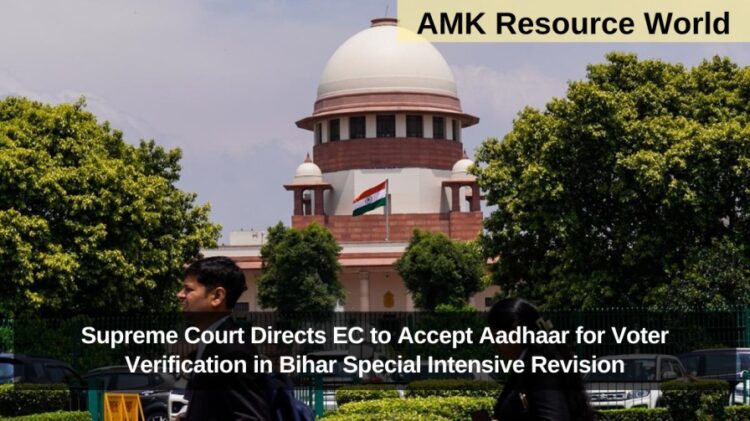
In a landmark decision, the Supreme Court of India has directed the Election Commission of India (EC) to accept Aadhaar as the 12th document for identity verification during the Special Intensive Revision (SIR) of electoral rolls in Bihar. This ruling aims to enhance voter inclusivity and ensure that no genuine voter is excluded due to strict documentation requirements ahead of the upcoming Bihar Assembly elections 2025.
Aadhaar as Identity Verification
The court clarified that while Aadhaar is not proof of citizenship, it can be used for identity verification purposes. The Election Commission retains the authority to verify the authenticity of Aadhaar cards just as it does for other approved documents. This ensures that voters who may lack traditional proof of identity can still participate in the democratic process without compromising electoral integrity.
Context Behind the Decision
The Supreme Court’s order comes amid growing concerns over disenfranchisement due to strict document requirements. Previously, the EC accepted 11 documents to establish identity and residence for inclusion in the electoral roll. However, petitions highlighted irregularities and refusals by Booth Level Officers (BLOs) who did not accept Aadhaar cards, potentially denying genuine voters their right to vote.
Under the Aadhaar Act, 2016, Aadhaar serves as a unique identity document but does not confer citizenship. The Representation of the People Act, 1950, allows the use of documents like Aadhaar for identity verification but not for determining citizenship. The Supreme Court emphasized that citizenship determination is beyond the scope of BLOs and must follow constitutional provisions involving the President and Election Commission.
Role of the Election Commission

The EC is responsible for finalizing electoral rolls and issuing instructions on acceptable documents. Following the court’s directive, the EC must update guidelines to include Aadhaar as a valid identity document during the Bihar SIR. Additionally, the EC may require additional proof to verify Aadhaar authenticity and address notices issued against officials accepting Aadhaar cards.
Implications for Voter Inclusion
The inclusion of Aadhaar is expected to reduce voter exclusion, particularly for those who do not possess traditional documents such as passports, driving licenses, or ration cards. While nearly 99.6% of Bihar’s voters have submitted conventional documents, Aadhaar offers a vital alternative for the remaining population. Nevertheless, concerns regarding forged Aadhaar cards necessitate robust verification procedures to prevent fraudulent enrolments and ensure election integrity.
This Supreme Court directive is a crucial step toward inclusive democracy in Bihar, ensuring that all eligible citizens can exercise their right to vote. By accepting Aadhaar as a recognized identity document during the Special Intensive Revision, the Election Commission can better achieve comprehensive voter registration, minimize errors, and strengthen the democratic process in the state.