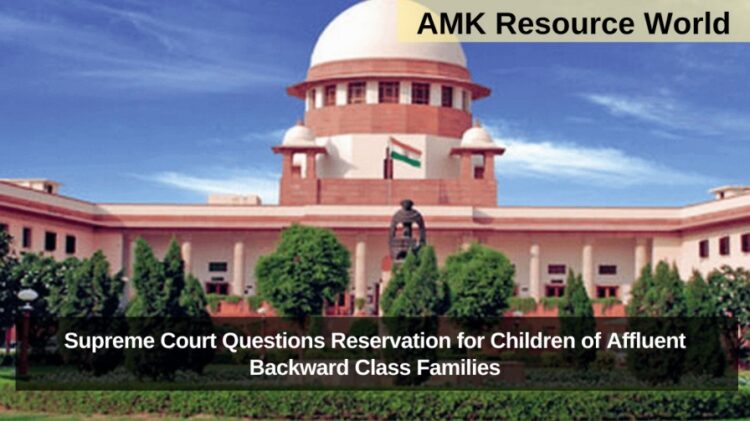
The Supreme Court raised important questions regarding the continued grant of reservation benefits to children belonging to economically and educationally advanced families within backward classes. The observations came while hearing a plea challenging a Karnataka High Court judgment that upheld the exclusion of a petitioner from reservation benefits after he was classified under the creamy layer category.
A bench comprising Justice B V Nagarathna and Justice Ujjal Bhuyan observed that once families achieve educational and economic empowerment through reservation, their children may no longer require the same benefits.
Key Highlights
- Supreme Court questioned reservation benefits for children of affluent backward class families.
- Bench observed that social mobility should reduce dependency on reservation.
- Karnataka case involved denial of caste validity certificate due to creamy layer classification.
- Petitioner’s parents were both government employees with income above the creamy layer limit.
- Court issued notice while hearing challenge against Karnataka High Court order.
- Supreme Court referred to the need for balancing social and economic backwardness.
- Previous 2025 case on excluding IAS and IPS officers’ children from SC/ST quotas was also discussed.
More Info
During the hearing, the Supreme Court remarked that if both parents are senior officers such as IAS officials, there should be reconsideration regarding continued reservation benefits for their children.
The bench observed that educational and economic advancement creates social mobility, and reservation benefits are intended primarily for genuinely disadvantaged sections.
According to the court, when parents secure stable and high-paying government jobs due to reservation benefits already availed by the family, extending the same benefits indefinitely to the next generation may defeat the purpose of affirmative action.
The court stated:
“If both parents are IAS officers, why should they have reservations? With educational and economic empowerment, there is social mobility.”
The judges further added that if students come from families where parents are well-employed and financially secure, they should gradually move out of reservation benefits so that opportunities can reach more deserving candidates.
Step by Step Process in the Karnataka Case
- The petitioner applied for appointment as Assistant Engineer (Electrical).
- He was selected under the reserved category.
- The District Caste and Income Verification Committee examined his eligibility.
- Authorities reviewed the income and employment status of his parents.
- Both parents were found to be government employees.
- Their combined annual income allegedly exceeded Rs 8 lakh.
- The petitioner was classified under the creamy layer category.
- His caste validity certificate was revoked.
- Karnataka High Court upheld the authorities’ decision.
- The petitioner challenged the judgment before the Supreme Court.
Creamy Layer and Reservation Rules Explained
The creamy layer concept applies mainly to Other Backward Classes (OBCs). It excludes economically advanced families from availing reservation benefits.
Under existing norms:
- Families earning above the prescribed income threshold are categorized as creamy layer.
- Children of certain high-ranking government officials may also fall under creamy layer exclusion.
- The current income limit commonly considered is Rs 8 lakh annually, though policies can change periodically.
The Supreme Court observed that reservation policies must maintain balance between social justice and equal opportunity.
The bench also noted that for Economically Weaker Sections (EWS), the basis is economic disadvantage rather than social backwardness. Therefore, reservation frameworks cannot be treated identically across all categories.
Previous Supreme Court Observation in 2025

The apex court also referred to an earlier matter heard in January 2025 involving a plea seeking exclusion of children of IAS and IPS officers from SC/ST reservation benefits in Madhya Pradesh.
In that case, the Supreme Court declined to entertain the plea. The court had clarified that observations regarding creamy layer exclusion from SC/ST reservation made in the seven-judge Constitution Bench judgment in the State of Punjab vs Davinder Singh Case were only judicial views and not enforceable law unless enacted by the legislature.
This means Parliament or state legislatures would ultimately have to decide whether creamy layer principles should formally apply to SC/ST reservations.
What’s Next
The Supreme Court has now issued notice in the present Karnataka matter. The case is expected to trigger wider debate on:
- Reservation reforms
- Creamy layer applicability
- Social mobility within backward classes
- Economic criteria in affirmative action policies
- Future scope of reservation benefits
The final ruling could significantly influence future reservation policies across states and central institutions.
Quick Reference Summary
| Particulars | Details |
| Case | Karnataka Creamy Layer Reservation Matter |
| Court | Supreme Court of India |
| Bench | Justice B V Nagarathna and Justice Ujjal Bhuyan |
| Main Issue | Reservation benefits for affluent backward class families |
| Petitioner’s Post | Assistant Engineer (Electrical) |
| Community | Kuruba Community |
| Reason for Rejection | Creamy layer classification |
| Income Threshold Mentioned | Rs 8 lakh |
| Current Status | Supreme Court issued notice |
Frequently Asked Questions
| What did the Supreme Court observe about reservation benefits? |
| The Supreme Court observed that children of economically and educationally advanced families within backward classes may no longer require reservation benefits after achieving social mobility. |
| What is the creamy layer concept? |
| Creamy layer refers to economically advanced members within OBC categories who are excluded from reservation benefits because of higher income or professional status. |
| Why was the petitioner denied reservation benefits? |
| The petitioner was denied benefits because both parents were government employees and their combined income exceeded the prescribed creamy layer limit. |
| Which community did the petitioner belong to? |
| The petitioner belonged to the Kuruba community and had initially received a caste certificate under the reserved category. |
| What job was involved in the Karnataka case? |
| The petitioner had been selected for the post of Assistant Engineer (Electrical) in Karnataka Power Transmission Corporation Limited. |
| Did the Supreme Court change reservation rules? |
| No. The Supreme Court has only issued observations and notice in the matter. Final decisions or policy changes are yet to come. |
| What did the court say about IAS officers’ children? |
| The bench questioned why children of IAS officers should continue receiving reservation benefits after families achieve educational and economic advancement. |
| Can creamy layer rules apply to SC/ST reservations? |
| Currently, the issue remains legally unsettled. The Supreme Court earlier stated that the legislature must decide whether creamy layer exclusion should apply to SC/ST quotas. |
The latest Supreme Court observations have once again brought the creamy layer debate into national focus. The Karnataka reservation case raises critical questions about balancing social justice with changing economic realities. As educational and financial mobility increases among sections benefiting from reservation, policymakers and courts may increasingly examine whether affirmative action should continue across generations without revised criteria.
The final outcome of this case could shape future reservation policies and redefine the scope of creamy layer exclusion in India.