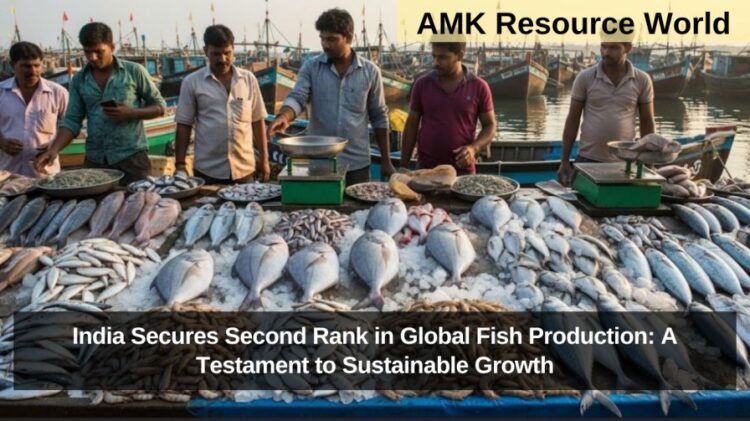
India has once again asserted its leadership in the global fisheries sector, securing the second position in fish production worldwide, according to Union Minister of Fisheries, Animal Husbandry and Dairying, Rajiv Ranjan Singh. The announcement was made during a high-level regional meeting held in Kolkata, where the minister engaged with key stakeholders and government representatives from West Bengal, Bihar, Jharkhand, and Chhattisgarh to chart a roadmap for enhancing fish production in the eastern region of the country.
The minister emphasized that India’s consistent performance in the fisheries sector is a reflection of strong policy frameworks, scientific aquaculture practices, and community-led efforts that have transformed fisheries into one of the country’s fastest-growing sectors. With vast inland and marine resources, India has successfully leveraged technology, infrastructure, and innovation to strengthen its fisheries economy, generate rural employment, and ensure nutritional security.
According to Singh, India’s rise to the second spot globally is not only a matter of pride but also an indicator of the sector’s untapped potential. He called for regional collaboration and localized strategies to further improve productivity and sustainability, particularly in states like West Bengal, which contribute significantly to India’s overall fish production.

The meeting in Kolkata aimed to identify region-specific challenges and opportunities, with a focus on increasing fish seed production, upgrading cold chain logistics, expanding fish feed manufacturing units, and promoting value-added products. Representatives from the participating states presented their progress under various central schemes such as the Pradhan Mantri Matsya Sampada Yojana (PMMSY), which has been instrumental in driving investment and modernization in the fisheries sector.
Singh acknowledged the critical role of small-scale and artisanal fishers and called for inclusive growth models that empower traditional fishing communities. He reiterated the government’s commitment to improving the welfare of fishers through infrastructure development, insurance coverage, access to credit, and skill development initiatives.
He also encouraged the states to harness blue economy strategies to ensure long-term sustainability of aquatic resources, while tapping into the rising demand for fishery exports. With India’s fisheries exports already commanding a significant share in the global market, especially in shrimp and other marine products, there is strong potential for further expansion.
The minister also highlighted the importance of promoting climate-resilient aquaculture, investing in research and development, and fostering private sector participation. The use of biofloc technology, recirculatory aquaculture systems, and digital tracking methods were discussed as future-forward interventions.
India’s second-place global ranking in fish production reaffirms its position as a fisheries powerhouse. The government’s proactive measures, combined with state-level innovation and stakeholder collaboration, are expected to further elevate India’s status in the global fisheries value chain, making it not only a leading producer but also a model of sustainable and inclusive growth in the sector.