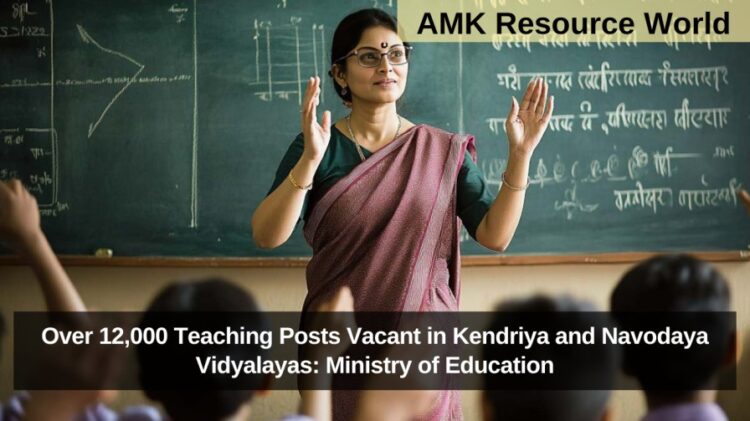
Over 12,000 teaching positions remain vacant across Kendriya Vidyalayas (KVs) and Jawahar Navodaya Vidyalayas (JNVs) in India, according to a written response by Union Minister of State for Education, Jayant Chaudhary, in the Rajya Sabha. The data, reported by PTI, sheds light on the pressing human resource gaps in central government-run schools catering to millions of students.
Chaudhary stated that 7,765 posts are vacant in Kendriya Vidyalaya Sangathan (KVS) while 4,323 remain unfilled in Navodaya Vidyalaya Samiti (NVS). These numbers highlight a significant challenge in maintaining consistent quality education and optimal teacher-student ratios across India’s centrally funded educational institutions.
Explaining the reasons behind the vacancies, the minister said that they are primarily due to retirement, resignation, promotion, transfer, deputation, and establishment of new schools. He added, “Vacancies also arise when employees proceed on lien to other departments or due to the upgradation of existing schools.”

To address the issue and ensure continuity in academic activities, contractual teachers are being appointed on a temporary basis. This provision helps mitigate immediate shortages but may impact long-term educational outcomes due to a lack of continuity and experience among temporary staff.
The minister further revealed that the recruitment process is being carried out in accordance with the prescribed recruitment rules, and efforts are underway to fill these vacancies. “The government is committed to ensuring that academic operations are not hampered due to staffing issues,” he said.
Additionally, 143 vacancies have been reported in Group A academic posts at the National Council of Educational Research and Training (NCERT) — the apex body responsible for curriculum development and teacher training in India. The minister assured that recruitment efforts are in progress to fill these key positions as well.
The large number of unfilled posts has raised concerns about the impact on student learning outcomes and the increasing burden on the existing teaching staff. With a significant portion of India’s school-going children dependent on these institutions, timely recruitment and teacher deployment are critical to achieving the government’s vision of quality and inclusive education.
The Ministry of Education’s response highlights both the magnitude of the challenge and the ongoing measures being taken to address the shortage in teaching personnel in some of India’s most respected school systems.