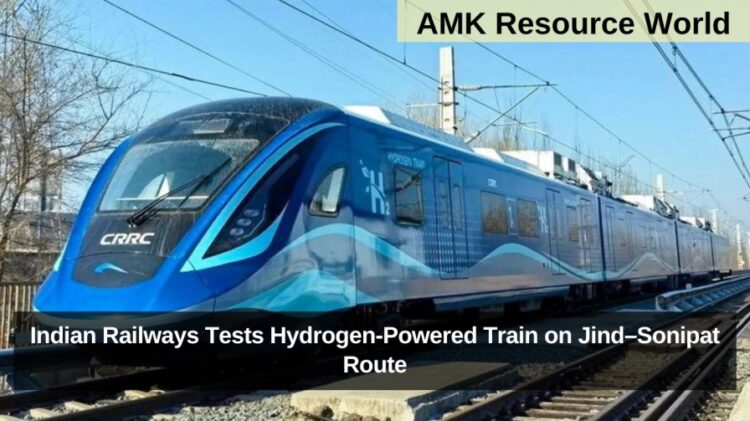
Indian Railways has successfully tested a hydrogen-powered train developed at the Integral Coach Factory (ICF) in Chennai, marking a major milestone in sustainable transport. The train is set to operate soon on the Jind–Sonipat route in Haryana, as part of India’s National Green Hydrogen Mission, which aims to produce five million metric tonnes of green hydrogen annually by 2030. This initiative aligns with India’s broader goal of achieving net zero carbon emissions by 2070.
Hydrogen Train Technology
The train operates using hydrogen fuel cells, which generate electricity to power the train motors without emitting carbon dioxide. Hydrogen is produced locally using a 1-MW polymer electrolyte membrane (PEM) electrolyser in Jind. The electrolyser splits water into hydrogen and oxygen using electricity sourced from renewable energy. The produced hydrogen is stored on the train and converted back into water in fuel cells, producing electricity to drive the train. This zero-emission process represents a clean alternative to diesel-powered trains.
Electrolyser and Fuel Cell Mechanism
Electrolysers work by splitting water molecules into hydrogen and oxygen using electricity. A polymer membrane allows only protons to pass through, separating hydrogen from oxygen. In the train’s fuel cell, the reaction is reversed: hydrogen molecules split into protons and electrons, with protons passing through the membrane and combining with oxygen to form water. The electrons flow through an external circuit, generating electricity to power the train, achieving efficient and sustainable energy conversion.
Green Hydrogen Production
Green hydrogen is produced entirely from electricity generated by renewable sources such as solar and wind, ensuring zero carbon emissions during production. India is actively expanding its renewable energy capacity to meet the National Green Hydrogen Mission targets. Innovative approaches like microbial electrolytic cells, which generate hydrogen from organic waste using microbes, are also being explored to enhance sustainability.

Cost and Material Challenges
A major challenge in hydrogen fuel technology is the reliance on expensive metals such as platinum and iridium in electrolysers and fuel cells. Research in India is focused on replacing these with cheaper metals like nickel, cobalt, and iron. Early successes include nickel-based electrodes, which perform comparably to platinum, helping to reduce costs and increase the feasibility of green hydrogen trains.
Significance and Future Prospects
With this deployment, India will join Germany, France, Sweden, and China in operating hydrogen-powered trains. The new train on the Jind–Sonipat route can carry 2,638 passengers, reach speeds of 110 km/h, and is powered by a 1,200 HP engine. The government has allocated Rs 2,800 crore to develop 35 hydrogen trains by 2024–25, signaling a major push towards sustainable and zero-emission transport in India.
This initiative not only supports India’s climate goals but also positions the country as a global leader in green transportation technology, combining innovation, renewable energy, and efficient public transport solutions.