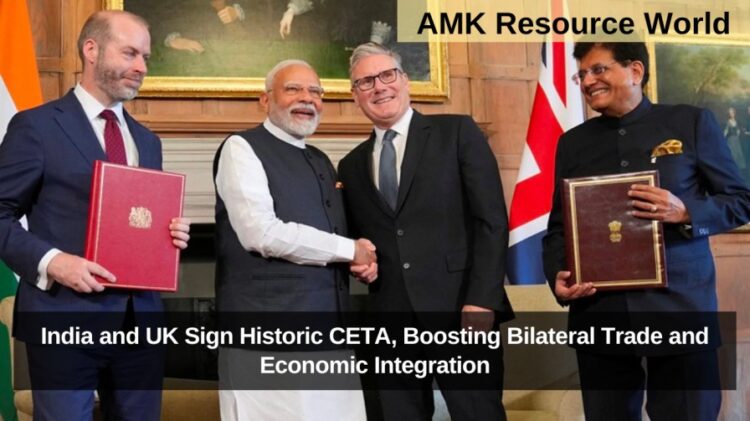
In a landmark move under the visionary leadership of Prime Minister Shri Narendra Modi, India and the United Kingdom have signed the Comprehensive Economic and Trade Agreement (CETA) on July 25, 2025, ushering in a new era of economic cooperation between the two nations. The agreement was signed by India’s Commerce and Industry Minister Mr. Piyush Goyal and UK Secretary of State for Business and Trade Mr. Jonathan Reynolds in the presence of both Prime Ministers.
CETA marks a pivotal milestone in India’s engagements with developed economies and signifies the deepening of India-UK ties in the post-Brexit landscape. Both countries—ranked as the fourth and sixth largest global economies respectively—aim to leverage this agreement to double bilateral trade, currently valued at USD 56 billion, by 2030.
A key highlight of CETA is the provision of unprecedented duty-free access for 99% of Indian exports to the UK. This strategic win will boost several labour-intensive and export-oriented sectors such as textiles, marine products, leather goods, toys, sports equipment, gems and jewellery, as well as high-growth industries including engineering goods, auto components, and organic chemicals.

The agreement also offers broad gains for India’s robust services sector, facilitating greater market access in IT, finance, legal, education, and digital trade. Indian professionals—ranging from software engineers and architects to chefs, yoga instructors, and musicians—will benefit from streamlined visa procedures and liberalised work entry provisions, ensuring smoother mobility and business engagement.
Commerce Minister Mr. Piyush Goyal lauded Prime Minister Modi’s leadership for achieving this historic accord. He stated, “This CETA marks a milestone in trade relations, unlocking tariff-free access for Indian exports and enabling Indian talent to thrive globally. It complements the ‘Make in India’ initiative and strengthens MSMEs, artisans, startups, and innovators.”
One of the key innovations in the agreement is the Double Contribution Convention, which exempts Indian workers and their employers from UK social security contributions for three years—boosting competitiveness and take-home pay for Indian professionals abroad.
With strong commitments on trade in goods and services, simplified professional mobility, and provisions to safeguard national interests, the India-UK CETA sets a high standard for future FTAs and propels India forward on its path to becoming a global economic powerhouse.