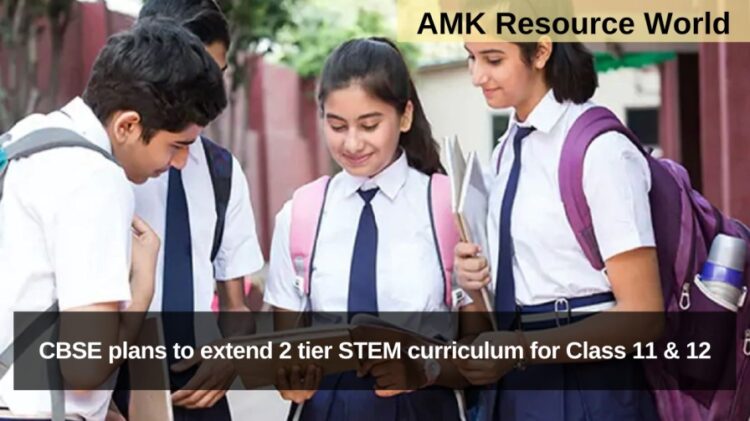
In a significant move aligned with the National Education Policy (NEP) 2020 and the National Curriculum Framework for School Education (NCFSE) 2023, the Central Board of Secondary Education (CBSE) is planning to introduce Science, Technology, Engineering, and Mathematics (STEM) subjects at two levels—basic and advanced—at the higher secondary stage. This reform is likely to begin with Class 11 students from the academic session 2026–27, The Sunday Express has learnt.
The CBSE has already implemented this dual-level model in Mathematics at the Class 10 level. Students can choose between a standard and basic version, both based on the same syllabus, but differing in the level of difficulty. In December last year, the CBSE’s governing body approved a similar framework for Science and Social Science for Classes 9 and 10. As per the approved plan, the model will be implemented in Class 9 from the academic year 2026–27.
Now, extending this model to the higher secondary stage, beginning with Class 11, represents a deeper shift in the academic architecture. Government officials have indicated that the timeline could be adjusted depending on the release of new NCERT textbooks and their adaptability to a two-level learning model. So far, textbooks revised under the NEP and NCFSE guidelines have been released for Classes 1 to 4, and Classes 6 and 7. Textbooks for Classes 5 and 8 are set to be released in the current academic year, while those for Classes 9 and 11 are expected later this year.

The dual-level model will allow students more academic flexibility. For instance, a Class 11 student interested in pursuing Humanities in higher education might choose to study Mathematics at the basic level, reducing the academic pressure without compromising their overall education. Similarly, a student aiming for a STEM career could opt for advanced-level Mathematics and Science, preparing them better for competitive exams and higher education.
This flexibility is a key recommendation of the NEP 2020, which advocates for multiple levels of difficulty within subjects to cater to diverse learner needs. The NCFSE similarly groups Classes 9 to 12 as a continuum called the “secondary stage” and recommends differentiated instruction and assessments based on students’ future aspirations.
In 2023, CBSE had piloted the advanced-level format for Mathematics, Science, and Social Science in Class 9 across select private schools. Feedback from students participating in this pilot indicated a positive response and a genuine interest in pursuing subjects at the advanced level, especially when given the option voluntarily.
CBSE is also evaluating ways to clearly reflect the level of difficulty on a student’s board examination results. One proposed method involves attaching a supplementary annexure to the question paper, offering additional questions for those who have opted for the advanced track.
This move marks a transformative step in Indian school education, aiming to personalise learning, reduce academic stress, and enhance college and career readiness among students.