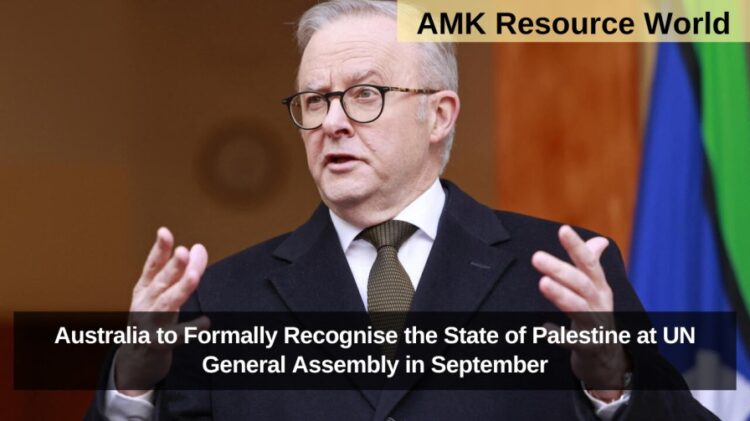
In a significant diplomatic move, Australian Prime Minister Anthony Albanese announced that Australia will formally recognise the State of Palestine during the United Nations General Assembly (UNGA) session in September 2025. The decision marks a pivotal moment in Australia’s foreign policy and underscores its commitment to advancing a two-state solution, fostering peace in the Middle East, and supporting international law.
Albanese stated that the recognition aims to help pave the way for renewed negotiations between Israel and the Palestinians, promote an immediate ceasefire in Gaza, and contribute to isolating Hamas, which Australia continues to designate as a terrorist organisation. “This is about supporting a just and lasting peace where both Israelis and Palestinians can live in security and dignity,” he emphasised.
The announcement follows similar decisions made in recent months by France, Britain, and Canada, all of which have formally acknowledged Palestinian statehood amid growing international frustration with the prolonged conflict. This wave of recognitions comes in response to Israel’s continued military operations in Gaza and the expansion of illegal settlements in the West Bank, both of which have been widely condemned by the global community as violations of international law and obstacles to peace.
Albanese made it clear that Australia’s recognition is conditional upon significant reforms within the Palestinian Authority (PA), aimed at improving governance, transparency, and accountability. The recognition also explicitly excludes Hamas from any future Palestinian government, aligning with Australia’s position that the militant group’s influence has hindered progress towards peace.

The Prime Minister’s stance reflects a growing sentiment among Western allies that the current trajectory of the Israeli-Palestinian conflict is untenable without decisive political action. “Recognition is not the end of the process; it’s the beginning of a renewed effort to achieve a negotiated peace,” Albanese said, noting that Australia will continue to work closely with international partners to facilitate dialogue between the two sides.
The decision is expected to generate both support and criticism domestically. Human rights groups and pro-Palestinian advocates have welcomed the move as a necessary step towards acknowledging Palestinian rights and aspirations for statehood. Conversely, some pro-Israel voices have expressed concern that recognition at this stage could embolden Palestinian hardliners or weaken Israel’s security position.
Internationally, the recognition is likely to add momentum to a broader diplomatic push to revive peace talks, which have been stalled for nearly a decade. By joining a growing coalition of nations recognising Palestine, Australia signals that it is prepared to take a principled stance in favour of a negotiated two-state solution, even amid heightened tensions in the region.
The Albanese government’s decision also aligns with Australia’s long-standing commitment to multilateral diplomacy and the rules-based international order. By formally recognising Palestine at the UNGA, Canberra is sending a message that constructive engagement, adherence to international law, and respect for the rights of both peoples are essential for lasting peace.
If successful, this diplomatic initiative could mark a turning point in Australia’s role in Middle Eastern affairs, setting the stage for deeper engagement in international efforts to resolve one of the world’s most enduring conflicts.