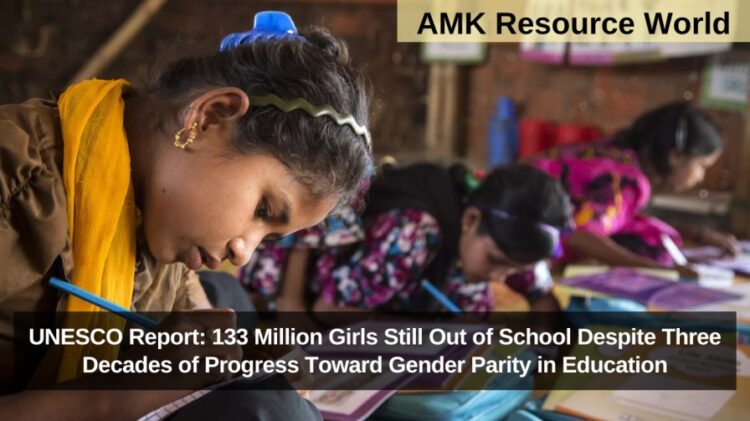
Nearly three decades after the Beijing Declaration and Platform for Action (1995) pledged to ensure the full and equal participation of women in all aspects of life, a new UNESCO Global Education Monitoring (GEM) Report reveals that while the world has made remarkable progress in achieving gender parity in education, the journey remains far from complete. According to the report, 133 million girls worldwide are still out of school, highlighting persistent inequalities that threaten the promise of education as a force for equality.
Global Progress in Girls’ Education Since 1995
The GEM team noted significant improvements in access to education for girls since 1995. “Girls now enrol in primary, lower, and upper secondary schools at rates nearly equal to boys. Globally, 91 million more girls are in primary education than three decades ago, and 136 million more are in secondary school,” a UNESCO GEM team member told PTI.
Women’s participation in higher education has also seen a dramatic surge. The report highlights that female enrolment in tertiary education has tripled, rising from 41 million in 1995 to 139 million in 2025. These milestones, the team said, “reflect decades of global effort to dismantle barriers and expand opportunity.”
However, the report warns that progress has been uneven, with millions of girls still denied the right to education due to poverty, conflict, location, and cultural norms.
Regional Disparities Persist Across the Globe
The UNESCO report underscores stark regional inequalities. While Central and Southern Asia have achieved gender parity in secondary school enrolment, sub-Saharan Africa continues to lag behind. In Oceania, where parity once existed, girls are now at a disadvantage. Conversely, in Latin America and the Caribbean, boys are less likely than girls to advance through secondary education.

“When poverty and geography intersect with gender, the disadvantages become even more severe,” the report said. “In countries like Guinea and Mali, almost no poor young women are in school.”
These disparities reveal how economic inequality, rural isolation, and entrenched gender norms continue to limit educational access for girls in many developing nations.
Beyond Enrolment: The Need for Transformation
UNESCO emphasized that the Beijing Declaration’s vision went beyond enrolment figures, calling for a transformative change in education systems. Yet, progress on this front has been patchy.
According to the report, comprehensive sexuality education is compulsory in only about two-thirds of countries at the primary level and three-quarters at the secondary level, leaving millions of young people without vital knowledge about health, safety, and consent.
Moreover, while women make up the majority of teachers globally, they remain underrepresented in leadership positions. Only 30% of higher education leaders worldwide are women, highlighting persistent gender gaps in educational leadership. Textbooks in many countries also continue to reinforce gender stereotypes rather than challenge them.
Call for Global Action and Accountability
The UNESCO GEM team called on governments to take urgent action to make education systems more inclusive, equitable, and transformative. “Curricula, teaching, and counselling must be gender-sensitive and empowering,” the report urged.
Governments are encouraged to expand sexuality education, protect learners from gender-based violence, and create pathways for women to enter leadership roles in education. The report also called for greater investment in data collection and accountability mechanisms to monitor progress.
“The unfinished business of girls’ education is not just about rights—it is about the future,” UNESCO said. “The promise made in Beijing remains possible, but only if we match evidence with action.”