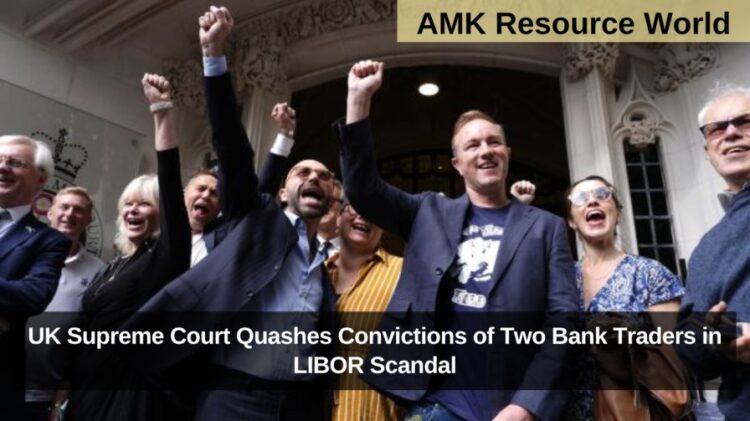
In a landmark ruling, the UK Supreme Court has overturned the criminal convictions of two former bank traders implicated in the high-profile LIBOR (London Interbank Offered Rate) manipulation scandal. The decision marks a significant moment in one of the most far-reaching financial misconduct cases in modern banking history.
The two individuals, Tom Hayes and Carlo Palombo, were previously found guilty of conspiracy to defraud for allegedly manipulating LIBOR—a benchmark interest rate used globally to set borrowing costs on trillions of dollars in financial contracts. Hayes, a former trader at UBS and Citigroup, was sentenced to 11 years in 2015, while Palombo, a former Barclays trader, was convicted in 2019.
However, in its recent judgment, the Supreme Court found that the prosecution’s interpretation of the law regarding dishonesty and market expectations was flawed. The court concluded that the traders’ actions, though ethically questionable by modern standards, did not meet the legal threshold for criminal dishonesty at the time under the applicable rules governing LIBOR submissions.
According to the justices, the existing LIBOR-setting rules lacked sufficient clarity, and there was no concrete legal standard that prohibited the types of communications or rate suggestions the traders were alleged to have made. The court emphasized that regulatory ambiguity played a central role, and the traders should not have been held criminally liable for behavior that had not been clearly defined as unlawful.

The judgment has prompted widespread debate among legal and financial experts. Some argue that the ruling exposes a serious weakness in financial regulation during the pre-crisis period, where self-regulation and informal standards allowed manipulative practices to flourish. Others welcome the ruling as a necessary correction of overreach in a regulatory environment that failed to define boundaries clearly.
The Financial Conduct Authority (FCA) and Serious Fraud Office (SFO) acknowledged the court’s decision and said they would assess its implications for other related cases. Meanwhile, Hayes, who served over five years in prison, described the ruling as a “vindication” and called for further review of similar convictions tied to LIBOR.
This ruling underscores the challenges of prosecuting financial crimes when regulatory frameworks lag behind market behavior, and it could influence future investigations into white-collar crime both in the UK and abroad. As regulatory bodies continue to evolve, the case serves as a reminder of the importance of legal clarity in complex financial markets.