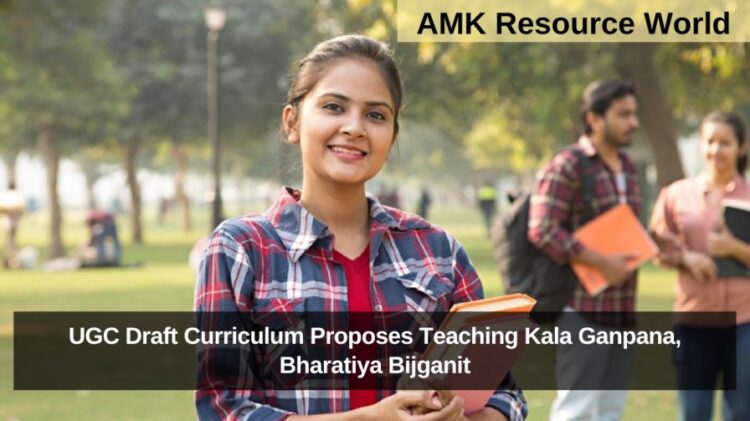
The University Grants Commission (UGC) has proposed a transformative draft curriculum under the National Education Policy (NEP) 2020, recommending the inclusion of Kala Ganpana (traditional Indian timekeeping), Bharatiya Bijganit (Indian algebra), and mathematical insights from the Puranas in undergraduate mathematics courses. The curriculum aims to showcase India’s rich heritage in astronomy, arithmetic, geometry, and algebra, while blending cultural and historical contexts with modern academic frameworks.
Mathematics Rooted in Bharatiya Tradition
According to the UGC draft, students will study the history and development of Bharatiya Bijaganita, including techniques such as Paravartya Yojayet Sutra, a traditional Vedic Mathematics method meaning “transpose and apply” used for division of polynomials. The curriculum also highlights basic arithmetic operations and geometric concepts from texts like the Narada Purana, demonstrating how ancient scholars connected mathematics with practical life, rituals, and cosmology.
The concept of Kala Ganpana (time reckoning) forms another key focus area. Students will explore how Panchanga (Indian calendar) determines muhurtas (auspicious timings) used in rituals and festivals, and how ancient systems of Ghatis and Vighatis compare with modern standards like Greenwich Mean Time (GMT) and Indian Standard Time (IST).
Linking Astronomy, Mythology, and Mathematics
The curriculum committee emphasizes a blended approach, merging astronomy, mythology, and culture. Students will learn about ancient observatories, the prime meridian of Ujjain, and cosmic time structures described in texts like the Surya Siddhanta and Aryabhatiyam. These works detail cycles of time ranging from Yugas and Kalpas to larger cosmic measures like Brahma Varsa (Brahma’s day), Vishnu Varsa, and Shiva Varsa.

By introducing these traditions, the UGC aims to give students a deeper appreciation of India’s role in the history of mathematics and astronomy, encouraging interdisciplinary research across sciences, economics, environment, and sustainable development.
Academic Framework: LOCF and Course Categories
The draft curriculum aligns with the Learning Outcomes-based Curriculum Framework (LOCF) under NEP 2020. Every discipline will feature three categories of courses:
- Discipline Specific Core (DSC): Compulsory credits within a chosen discipline.
- Discipline Specific Electives (DSE): Optional credits within related disciplines.
- Generic Electives (GE): Courses outside the core discipline offering multidisciplinary exposure.
For mathematics, DSC courses will cover topics such as Vedic algebra, geometric interpretations from Puranas, and Indian methods of timekeeping, while electives may expand into comparative studies of ancient and modern mathematical systems.
Vision for a Transformative Education
Professor Sushil K Tomar, chair of the curriculum committee, stated:
“We are confident that this curriculum will be a transformative initiative in mathematics education in India. It has been meticulously developed through extensive consultation and collaboration, ensuring both academic excellence and practical relevance.”
He added that the framework aspires to produce graduates who are professionally competent, capable of contributing to innovation, research, and national development.
Beyond Mathematics: Political Science Integration
Interestingly, the UGC’s draft also proposes reforms in political science, with 20 four-credit DSC courses including “Tradition of Political Thinking in Bharat”, which introduces students to Vedic traditions, Jain and Buddhist literature, Upanishads, Ramayana, Mahabharata, and Thirukkural. This reflects the NEP’s vision of embedding Bharatiya knowledge systems across disciplines.