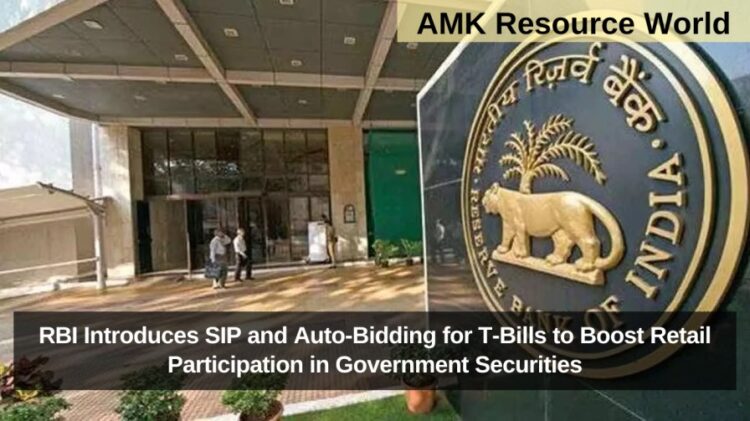
In a significant move to enhance retail participation in government debt markets, the Reserve Bank of India (RBI) introduced two investor-friendly features on its Retail Direct platform in August 2025. These include the Systematic Investment Plan (SIP) for Treasury Bills (T-Bills) and an auto-bidding facility. Both initiatives aim to simplify investment processes, promote financial discipline, and make government securities more accessible to individual investors.
Understanding Treasury Bills (T-Bills)
T-Bills are short-term government debt instruments used to meet immediate liquidity needs. They are issued for tenures of 14, 91, 182, and 364 days and are considered among the safest investment options, backed by the sovereign guarantee of the Government of India. Sold at a discount and redeemed at face value, T-Bills offer risk-averse investors a way to earn better returns than standard savings accounts, especially for those with short-term surplus funds.
RBI’s Retail Direct Platform
Launched in 2021, the RBI Retail Direct platform has been a game-changer in democratizing access to Government Securities (G-Secs). It enables individual investors to directly open gilt accounts, participate in primary auctions, and trade G-Secs in the secondary market without the need for intermediaries. The platform also facilitates the purchase of Sovereign Gold Bonds and Floating Rate Savings Bonds, promoting a culture of secure and transparent investing among retail investors.
Systematic Investment Plan (SIP) in T-Bills
The newly introduced SIP feature allows retail investors to make small, periodic investments in T-Bills, rather than investing large sums at once. This promotes disciplined investing and helps build a rolling portfolio of short-term instruments. It is particularly beneficial for those saving for short- to medium-term financial goals, like emergency funds or upcoming expenses. As T-Bills mature, investors can choose to reinvest, creating a sustainable investment cycle with minimal effort.

Auto-Bidding for Seamless Investing
With the auto-bidding feature, the entire process of bidding for T-Bills in the primary market becomes automated. Investors can define their preferences regarding amount, tenure, and frequency. The system then automatically places bids during scheduled auctions and uses the National Automated Clearing House (NACH) to handle payments. This eliminates the need for constant manual monitoring, ensuring consistent investment participation with ease.
Benefits and Challenges
These features lower the entry barrier for retail investors and encourage prudent financial planning. T-Bills offer secure returns over fixed durations, and the new tools make investing more efficient and accessible. However, liquidity remains a challenge—T-Bills are best suited for investors with fixed investment horizons, as early exit through the secondary market might not always be feasible.
Broader Impact
By promoting retail participation in short-term government securities, RBI’s latest initiative could reduce dependence on institutional investors and enhance market depth and liquidity. It empowers individuals to better utilize idle funds in their bank accounts and supports the development of a more inclusive and robust public debt market. In the long run, such measures could play a pivotal role in strengthening financial literacy and building a more stable investment culture in India.