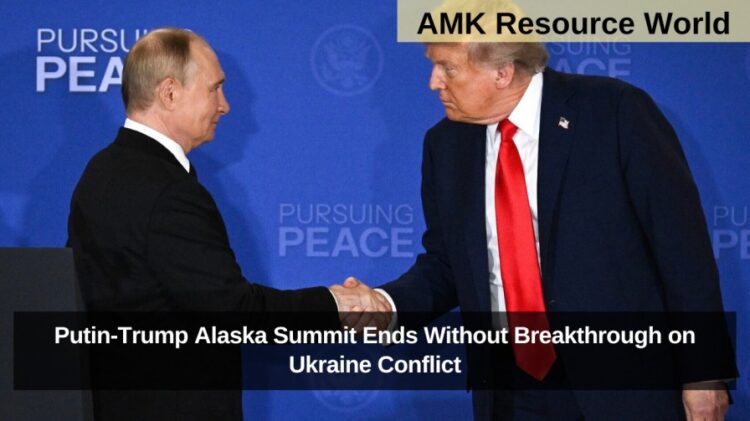
The much-anticipated summit between Russian President Vladimir Putin and former U.S. President Donald Trump in Alaska concluded without a breakthrough on the Ukraine conflict, despite nearly three hours of closed-door talks at the Elmendorf-Richardson military base. While both leaders described the meeting as “productive,” they acknowledged that no concrete deal had been reached.
Talks End Without Agreement
The Alaska meeting was closely watched by global observers hoping for signs of progress in the protracted Ukraine war. However, the summit ended without a roadmap for peace. Putin stressed the need to address the conflict’s root causes, insisting that without tackling underlying security concerns, any superficial solution would be unsustainable. He also issued a cautionary note, warning against what he described as “sabotage” by external actors who, in his view, have a vested interest in prolonging the war.
Trump, meanwhile, struck a more measured tone, emphasizing the importance of keeping communication channels open. He underscored the value of dialogue and cooperation but also pointed out that any final resolution would ultimately depend on Ukraine and NATO’s role in negotiations. His remarks suggested that while Washington could act as a mediator, it cannot unilaterally dictate terms.
Cautious Optimism in Joint Press Conference
Following the talks, both leaders held a brief joint press conference. Their remarks reflected cautious optimism, though without tangible commitments. Putin reiterated Moscow’s readiness for discussions aimed at a lasting settlement, while Trump said that progress would be possible only if all parties showed flexibility and sincerity.

Despite the absence of an agreement, the willingness of both leaders to meet and engage directly was interpreted as a positive signal amid rising global tensions. Analysts suggest that even modest diplomatic exchanges could pave the way for incremental steps toward de-escalation in the future.
Broader Geopolitical Context
The Alaska summit comes at a time when the Ukraine conflict continues to shape international security and energy markets. The war has strained Russia’s relations with the West, deepened divisions within NATO, and disrupted global supply chains. Against this backdrop, the meeting between Putin and Trump—though symbolic—highlighted the urgency of renewed diplomatic efforts.
Trump’s reemergence on the global stage also carries symbolic weight, as he has often advocated for dialogue with Moscow, even when such positions drew criticism during his presidency. Putin, for his part, appeared keen to signal Russia’s openness to negotiations, provided its security concerns are acknowledged.
No Immediate Resolution, But a Step Forward
While no breakthroughs were achieved in Alaska, the meeting itself is being described by some observers as a step forward. Direct dialogue, even without agreements, helps keep the door open for future talks. The summit reaffirmed that both sides, despite deep differences, recognize the importance of maintaining communication at the highest levels.
For now, the Ukraine conflict remains unresolved, with no clear path to peace in sight. However, the Alaska summit may be remembered as a moment that kept dialogue alive—an essential ingredient in any eventual settlement.