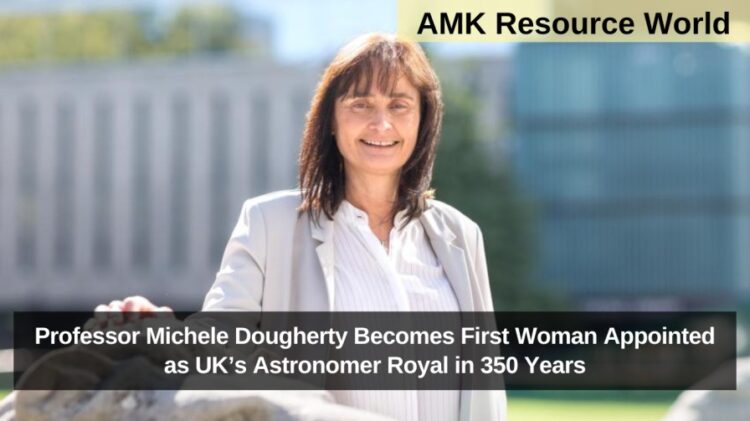
In a landmark moment for science and gender representation, Professor Michele Karen Dougherty has been appointed as the sixteenth Astronomer Royal of the United Kingdom, making history as the first woman to hold the prestigious position since its inception 350 years ago.
The title of Astronomer Royal was established in 1675 by King Charles II, alongside the creation of the Royal Observatory at Greenwich. It is a highly respected honorary role that includes advising the British monarchy on astronomical matters and promoting public interest in science and space exploration. The first to hold the post was John Flamsteed, while Professor Dougherty succeeds Martin John Rees, Baron Rees of Ludlow, who served from 1995 to 2025.
Professor Dougherty, a renowned physicist, is internationally acclaimed for her pivotal role in NASA’s Cassini mission to Saturn, during which she led groundbreaking work that helped identify jets of water vapor erupting from Saturn’s moon Enceladus. This finding has profound implications for space science, as it suggests that Enceladus may harbor conditions suitable for life, fueling global interest in astrobiology and planetary science.

Her appointment as Astronomer Royal reflects not only her exceptional scientific contributions but also her role as a trailblazer for women in science. Dougherty’s career has consistently broken new ground, and she has become a symbol of excellence, leadership, and inclusivity in a traditionally male-dominated field.
The British scientific community has welcomed her appointment, viewing it as a step forward in diversifying the face of UK science leadership. Beyond the ceremonial aspects, the role allows Dougherty to influence science communication, education, and public engagement, areas she has long championed.
As the new Astronomer Royal, Professor Michele Dougherty brings a visionary perspective rooted in both scientific rigor and public outreach. Her tenure promises to inspire the next generation of astronomers and space explorers, especially young women and underrepresented groups, by showing that the cosmos belongs to all.
Her historic appointment marks a transformative moment for British astronomy and further cements her legacy as a pioneer in space science and gender equality in STEM.