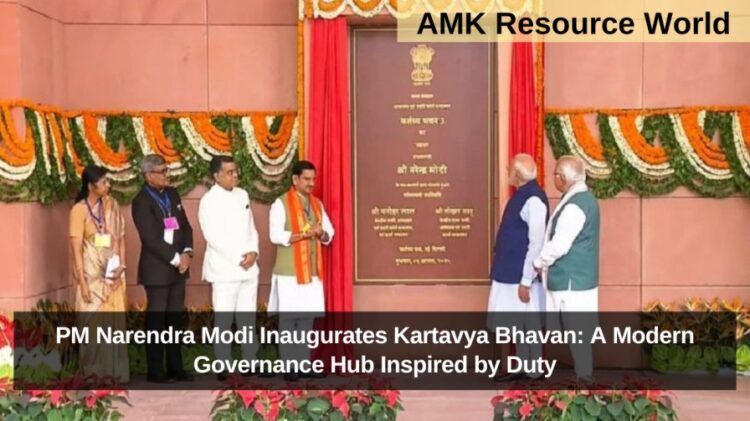
In a significant stride towards transforming India’s administrative architecture, Prime Minister Narendra Modi inaugurated Kartavya Bhavan on Kartavya Path in New Delhi, envisioning it as a modern hub for governance and a symbol of the nation’s forward-looking administrative ethos. The name, inspired by the Bhagavad Gita’s principle of Nishkama Karma (selfless duty), reflects a deep commitment to the ideals of accountability, service, and duty towards the nation.
A New Era of Administrative Efficiency
Kartavya Bhavan has been conceptualized to co-locate several key ministries, including the Ministry of Home Affairs, Ministry of External Affairs, Ministry of MSME, Ministry of Petroleum & Natural Gas, among others. By bringing together these ministries under a single roof, the facility is expected to boost inter-departmental coordination, reduce redundancy, and streamline policy-making processes.
In his address during the inauguration, PM Modi remarked, “Kartavya Bhavan is not merely a new building—it is the nerve centre of New India’s governance model. It reflects our resolve to discard colonial legacies and embrace infrastructure that is designed for a developed India.”
Replacing Colonial-Era Inefficiencies
The Prime Minister emphasized that the new facility would help phase out the use of outdated, colonial-era government buildings that suffer from poor infrastructure, high maintenance costs, and expensive rental burdens. In contrast, Kartavya Bhavan represents a cost-effective, energy-efficient, and citizen-centric approach to governance.
Sustainable and Smart Infrastructure

Spanning over 1.5 lakh square meters, Kartavya Bhavan has been built with an emphasis on sustainable and smart design. The infrastructure integrates IT-ready workspaces, modular offices, and state-of-the-art security systems. It has been designed to achieve a GRIHA-4 rating—a national benchmark for green buildings in India.
Among its key environmental features are:
- Solar power generation systems
- Rainwater harvesting units
- Zero-discharge waste management system
- Energy-efficient lighting and ventilation
These initiatives align with India’s broader goals of environmental sustainability and climate-resilient urban infrastructure.
Governance Through Duty
The Prime Minister’s choice of the name “Kartavya Bhavan” underscores a philosophical shift—from a bureaucratic, entitlement-based administration to one that is duty-bound and citizen-focused. It resonates with Modi’s earlier decision to rename Rajpath as Kartavya Path, reinforcing a consistent theme in his governance narrative—duty above all.
The building stands as a symbol of India’s administrative reforms and digital governance push, offering a modernized workplace for thousands of government employees and facilitating faster policy implementation.
With the inauguration of Kartavya Bhavan, the government has taken a concrete step towards creating a future-ready bureaucracy, aligning with the vision of Viksit Bharat (Developed India) by 2047. It is not just a physical structure but a representation of a new governance culture—rooted in tradition, driven by technology, and inspired by the unwavering spirit of duty.