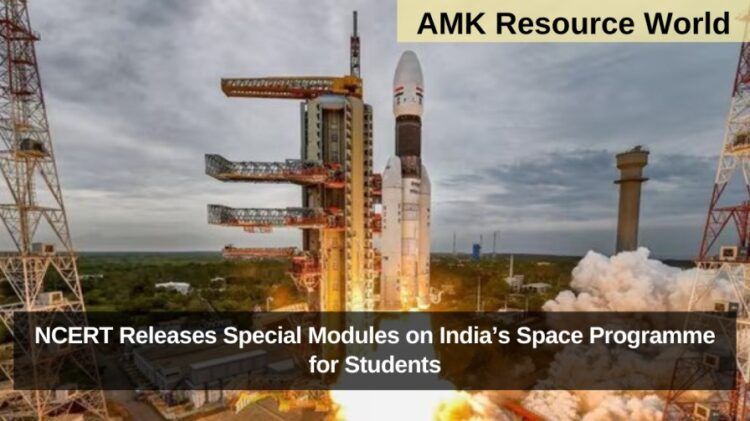
The National Council of Educational Research and Training (NCERT) has launched special educational modules titled “India: A Rising Space Power”, designed to trace India’s journey from humble beginnings in the 1960s to becoming a global space powerhouse. These modules, aimed at middle-stage and secondary students, use photographs, diagrams, and timelines to help learners understand the evolution of India’s space programme and its contributions to science and society.
The modules highlight the role of the Indian National Committee for Space Research (INCOSPAR), established in 1962 under Vikram Sarabhai, which later grew into the Indian Space Research Organisation (ISRO). ISRO’s approach, noted for being low-cost, high-tech, and self-reliant, has led to a series of landmark missions that have earned India a distinguished position in global space research.
Key milestones in India’s space journey are detailed in the NCERT modules. The launch of Aryabhata in 1975, India’s first satellite, and the Satellite Instructional Television Experiment (SITE), which brought television to rural India, set the foundation for scientific progress. Missions like Chandrayaan-1, which discovered water molecules on the Moon, Mangalyaan (Mars Orbiter Mission, 2013), which made India the first Asian country to reach Mars on its maiden attempt, and Chandrayaan-2 (2019), whose orbiter continues to provide crucial lunar data, are extensively covered.

The modules also celebrate India’s human spaceflight achievements, including Squadron Leader Rakesh Sharma, the first Indian in space (1984), and Group Captain Shubhanshu Shukla, the first Indian to stay on the International Space Station (ISS) in June 2025. The upcoming Gaganyaan mission aims to send a three-member crew to a 400 km low Earth orbit for three days, while future projects include Chandrayaan-4, a Moon sample return mission, and the Bharatiya Antariksh Station (BAS), India’s first space station for long-duration missions.
India’s space programme is not just about exploration. The modules emphasize the practical applications of space technology in everyday life, including NavIC, India’s indigenous navigation system, tele-education, telemedicine, disaster management, and real-time information services. ISRO’s achievement as a low-cost launch hub is also highlighted, having conducted 131 spacecraft missions, 101 launch missions, and launched over 430 foreign satellites from 35 countries.
The modules further shed light on India’s space startups and the government’s ambition to capture 8% of the global space economy by 2035. With ongoing collaborations with ISRO and international agencies, India is poised to strengthen its position as a reliable and innovative space power.
NCERT’s educational initiative ensures that students not only learn about India’s space milestones, such as Chandrayaan-3, Aditya-L1, and NISAR, but also understand the broader impact of space technology on society and development. By combining history, science, and practical applications, the modules inspire the next generation of scientists, engineers, and space enthusiasts to contribute to India’s continuing journey in space exploration, for more details and download special modules CLICK HERE