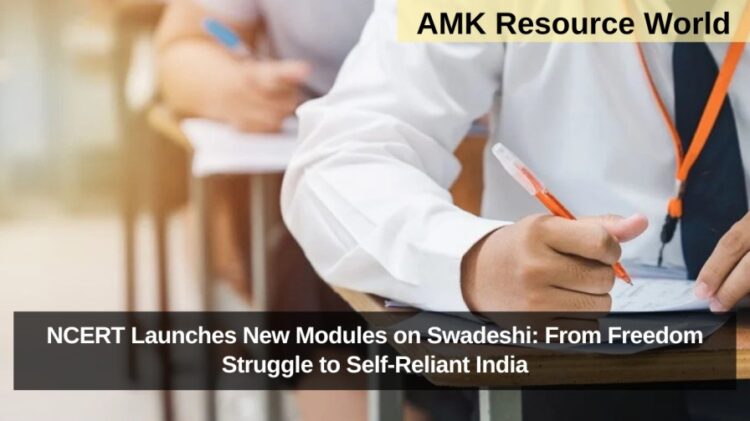
The National Council of Educational Research and Training (NCERT) has launched two new educational modules that bring the concept of Swadeshi into the contemporary classroom. These modules trace Swadeshi’s journey from its historic origins during India’s freedom struggle in 1905 to Prime Minister Narendra Modi’s vision of a self-reliant, developed India (Viksit Bharat).
In his Independence Day address 2025, Prime Minister Modi emphasized that “Self-Reliant Bharat” is the foundation of a developed India, calling upon citizens to support local manufacturing and innovation. In a recent interaction with award-winning teachers, he urged educators to inspire students to choose Swadeshi products, aligning with the “Make in India” and “Vocal for Local” initiatives.
NCERT’s new modules—“Swadeshi: Vocal for Local” (for middle stage) and “Swadeshi: For a Self-Reliant India” (for secondary stage)—feature excerpts from the Prime Minister’s address, reinforcing how self-reliance can drive the nation’s journey toward Viksit Bharat.
Roots in the Freedom Struggle
The modules revisit the Swadeshi movement that emerged in 1905 during the partition of Bengal. The movement was a powerful economic and cultural response against British exploitation, urging Indians to boycott foreign goods and promote indigenous industries.
The spirit of Swadeshi led to the birth of several Indian enterprises such as Bengal Chemical and Pharmaceutical Works founded by Acharya Prafulla Chandra Ray in 1901 and the Tata Iron and Steel Company (now Tata Steel) founded by Jamsetji Tata in 1907.

Interestingly, former Rajya Sabha MP Tarlochan Singh has requested NCERT to credit Baba Ram Singh, leader of the Namdhari sect, for initiating Swadeshi as early as 1860, predating the Bengal movement.
Modern Interpretation of Swadeshi
The new modules link the historic Swadeshi ethos to India’s modern achievements in space, defence, health, and technology. They draw inspiration from Mahatma Gandhi’s philosophy of Swadeshi in education and Rabindranath Tagore’s vision of creative self-development.
Today, Swadeshi resonates through national programmes like Make in India, Start-up India, Digital India, Vocal for Local, and Atmanirbhar Bharat. These initiatives aim to boost local entrepreneurship, innovation, and manufacturing, aligning with India’s goal of becoming a global economic leader.
The modules highlight success stories such as Amul in the dairy sector, ISRO in space exploration, and Ayurveda in global wellness, showcasing how self-reliant models can create sustainable growth and international recognition.
Swadeshi in the Digital Age
In a forward-looking approach, NCERT connects Swadeshi to the digital revolution, particularly artificial intelligence (AI). The modules emphasize that “AI today is as vital as cotton and steel were during the freedom struggle,” underscoring the need for homegrown AI solutions to ensure data security and address India-specific challenges.
Drawing parallels with nations like Israel and Vietnam, the modules assert that Swadeshi can once again become a tool for national resilience—this time in technology, renewable energy, agriculture, and manufacturing.
By reviving the Swadeshi spirit, NCERT aims to instil in students a sense of pride, innovation, and responsibility—values that are essential to building a self-reliant India ready to lead the world in the 21st century, for more details and download CLICK HERE