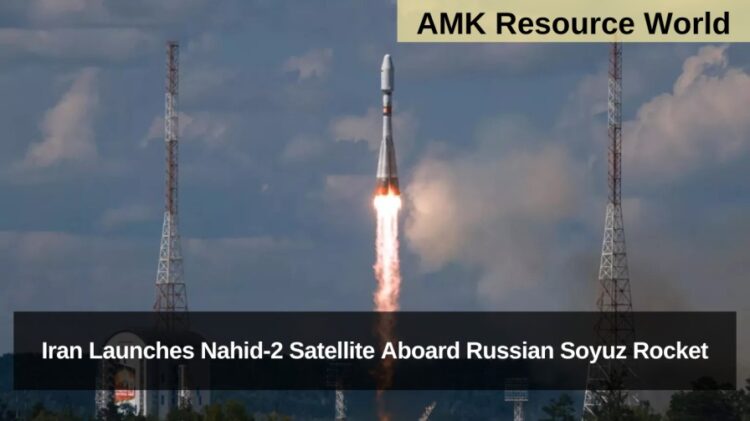
In a significant advancement of its space capabilities, Iran successfully launched its telecommunications and research satellite, Nahid-2, aboard a Russian Soyuz rocket as part of a multi-payload mission involving several international satellites. The launch reinforces the growing space cooperation between Iran and Russia, and highlights Iran’s progress in building indigenous satellite technologies.
The Nahid-2 satellite, developed by the Iranian Space Agency, is designed to function in low Earth orbit (LEO) for five years. One of its standout features is its indigenous propulsion system, which allows it to adjust its altitude by up to 50 kilometers, enhancing orbital stability and enabling better control for scientific and communications applications. This system marks a significant technological leap for Iran’s satellite program, demonstrating greater self-reliance in advanced space systems.
Nahid-2 is intended for dual-purpose use — it will assist in telecommunications experiments and research, including signal relay, satellite control, and transmission technologies. This functionality is vital for improving Iran’s communications infrastructure and scientific capabilities in orbit.

The Soyuz rocket, a veteran in global space launches, was selected for its reliability and multi-payload capability. Alongside Nahid-2, the mission carried satellites from several other countries, further demonstrating the Soyuz platform’s international role in space deployment.
This launch is not the first instance of Iran’s reliance on Russia for satellite deployment. Over the past few years, Russia has launched several Iranian satellites, including Khayyam, Pars-1, Kosar, and Hodhod. This continuing collaboration underscores a strategic partnership between Tehran and Moscow, particularly in the realm of space technology and research, where both nations seek to expand capabilities while countering Western restrictions and sanctions.
Iranian officials hailed the successful launch of Nahid-2 as a symbol of national scientific progress and a step forward in developing a resilient and self-sufficient space program. They also emphasized the satellite’s role in supporting long-term research and technological applications across civilian and defense sectors.
As global competition intensifies in outer space, Iran’s successful deployment of Nahid-2 through Russian support illustrates its commitment to advancing national interests through space exploration — and the strengthening of a geopolitical alliance with Russia through shared scientific and strategic goals.