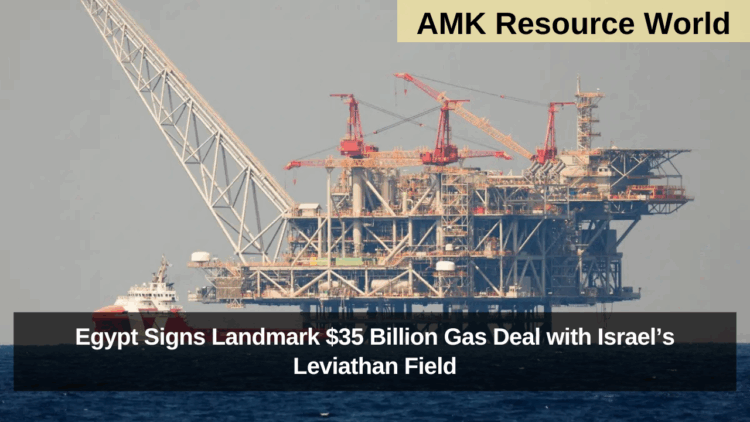
In a historic step for regional energy cooperation, Egypt has signed a $35 billion agreement to import natural gas from Israel’s Leviathan gas field—marking the largest export deal in Israel’s history. Announced by Newmed Energy on August 7, the deal underscores a growing energy partnership between the two nations despite the persistent geopolitical tensions in the Middle East.
Under the agreement, Israel will supply Egypt with approximately 130 billion cubic meters (bcm) of natural gas by 2040. Deliveries are scheduled to begin in early 2026, with the deal involving Newmed Energy, its Leviathan partners, and Blue Ocean Energy. This contract represents Egypt’s most significant long-term energy supply commitment as it seeks to address rising domestic energy demands driven by its rapidly growing population and expanding industrial base.
Leviathan’s Expanding Role in Regional Energy
Located off Israel’s Mediterranean coast, the Leviathan gas field is estimated to hold around 600 bcm of reserves. Since its development, the field has emerged as a central hub for Israel’s energy exports. Under existing contracts, it already supplies Egypt with roughly 4.5 bcm of gas annually, alongside deliveries to Jordan and other regional partners.
With the new deal, Leviathan’s role in powering Egypt’s economy will grow substantially. The expanded supply is expected to boost Egypt’s domestic electricity generation, provide feedstock for its industries, and support its ambitions to become a regional hub for liquefied natural gas (LNG) exports to Europe and Asia.

Strategic Energy Partnership Amid Tensions
The agreement comes at a time when Middle Eastern geopolitics remain complex. However, energy cooperation has often served as a bridge between countries with differing political stances. By strengthening their economic interdependence, Egypt and Israel are reinforcing a pragmatic approach to regional stability.
Industry analysts note that this deal not only diversifies Egypt’s energy supply but also enhances Israel’s status as a significant natural gas exporter. For both nations, the agreement offers mutual benefits—economic growth, job creation, and increased energy security.
Economic Outlook and Domestic Impact
Egypt’s economy has been showing signs of recovery. The International Monetary Fund (IMF) recently revised its growth forecast for 2024–2025 to 3.8%, while Egypt’s central bank projects a 4.3% expansion for 2023–2024, up from 2.4% in the previous year. Access to stable, long-term energy supplies will be critical to sustaining this upward trajectory, especially as Egypt invests in infrastructure, manufacturing, and urban development.
By securing a 14-year supply of natural gas, Egypt will be better positioned to meet growing electricity demands, reduce reliance on more expensive fuel imports, and stabilize domestic energy prices.
The $35 billion Leviathan deal represents more than just a commercial transaction—it is a strategic alliance that could shape the region’s energy future. With production ramp-ups planned and new infrastructure in the works, both Egypt and Israel stand to gain economically and politically from this unprecedented agreement.
As deliveries commence in 2026, the partnership may serve as a model for how shared energy interests can foster cooperation in a region often marked by division.