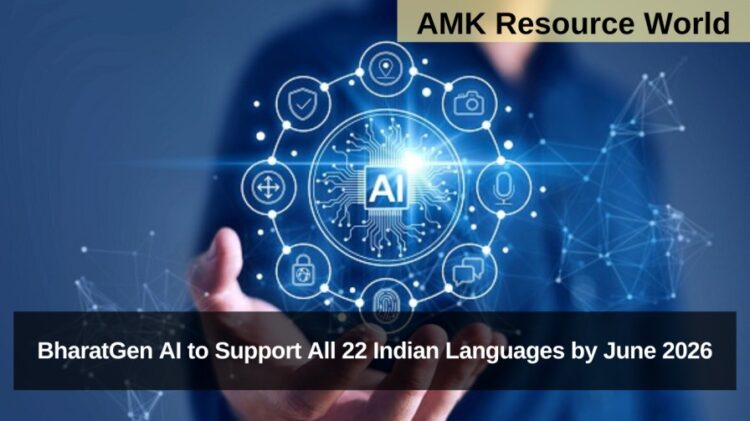
In a significant step towards digital inclusivity, the Government of India has announced its plan to make BharatGen AI fully support all 22 Eighth Schedule languages by June 2026. The initiative, revealed by Union Minister of State for Science and Technology Dr. Jitendra Singh, underscores the country’s commitment to harnessing artificial intelligence for equitable access to technology across India’s rich linguistic spectrum.
BharatGen AI is part of the government’s broader vision to build an inclusive AI ecosystem under the National Mission on Interdisciplinary Cyber-Physical Systems (NM-ICPS), spearheaded by the Department of Science and Technology (DST). The mission aims to ensure that AI-powered digital tools, platforms, and services are available to every citizen, regardless of their native language.
India’s Eighth Schedule of the Constitution lists 22 officially recognized languages, ranging from widely spoken tongues such as Hindi, Bengali, and Tamil to regionally significant languages like Manipuri, Bodo, and Santali. However, the linguistic diversity that enriches the nation has also presented challenges for digital penetration and adoption. While English and Hindi dominate most digital platforms, millions of Indians face barriers when accessing online resources in their own languages.
Minister Singh emphasized that BharatGen AI’s multilingual capabilities will bridge this gap. By integrating advanced natural language processing (NLP) models, the platform will facilitate not just translation, but also context-aware interpretation and conversation in every scheduled language. “Digital inclusivity is not just about internet access—it is about making sure that the internet speaks your language,” he said.

The project involves significant research and development in language technologies, including speech-to-text, text-to-speech, machine translation, and AI-assisted content generation. These capabilities will cater to a wide array of applications, from education and healthcare to e-governance and agriculture. For instance, farmers in rural Odisha will be able to receive government advisories in Odia, while small business owners in Nagaland can access digital financial tools in Ao or other local languages.
By the June 2026 deadline, BharatGen AI aims to become a truly pan-Indian platform, enabling voice assistants, chatbots, e-learning platforms, and public service portals to operate seamlessly in all 22 languages. This could significantly reduce the digital divide, empower marginalized linguistic communities, and foster inclusive growth.
The DST is also working with academic institutions, AI research labs, and private sector partners to accelerate the development of high-quality language datasets—a critical requirement for training AI systems in diverse Indian languages. Initiatives to crowdsource language data and engage local communities are expected to play a key role in ensuring accuracy and cultural relevance.
Experts believe this initiative could position India as a global leader in multilingual AI, offering models that could be adapted to other linguistically diverse regions. With BharatGen AI’s upcoming expansion, the country moves a step closer to its vision of a digitally empowered society, where language is no longer a barrier to information, innovation, and opportunity.
If implemented successfully, June 2026 could mark a milestone in India’s AI journey—one where technology finally speaks the language of every citizen.