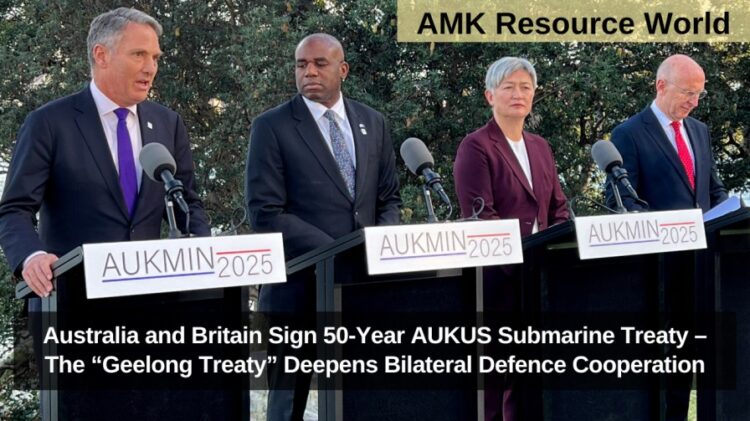
In a historic move that cements half a century of strategic partnership, Australia and the United Kingdom have signed a landmark 50-year defence treaty under the AUKUS pact, focusing on the joint development and deployment of nuclear-powered submarines. Dubbed the “Geelong Treaty”—named after the Australian city where the agreement was formalised—the treaty marks one of the most significant long-term military collaborations in recent history.
The Geelong Treaty is part of the broader AUKUS (Australia-UK-US) defence alliance, launched in 2021, aimed at countering emerging regional threats, especially in the Indo-Pacific. This new bilateral agreement between Australia and Britain is designed to deepen defence and industrial ties, focusing on the construction and maintenance of a new fleet of nuclear-powered submarines. These submarines, based on British designs and built using advanced U.S. nuclear propulsion technology, are expected to enter service in the 2040s.
Australian Prime Minister Anthony Albanese described the agreement as “a monumental step forward for our national defence and industrial capability.” His British counterpart, Prime Minister Keir Starmer, called the treaty a “symbol of unwavering trust and shared values,” underlining the strategic necessity of cooperation in a rapidly changing global landscape.

Under the terms of the Geelong Treaty, Australia will build most of its new SSN-AUKUS submarines domestically in Adelaide, creating thousands of high-skilled jobs and ushering in a new era of local defence manufacturing. The UK will simultaneously expand its submarine production at Barrow-in-Furness. Experts estimate that the partnership will generate billions of dollars in economic returns for both nations over the life of the treaty, with significant investment flowing into technology, infrastructure, training, and advanced manufacturing sectors.
The treaty also includes provisions for joint crew training, shared maintenance responsibilities, and integrated defence planning, ensuring both nations are strategically aligned in the deployment and operation of the submarines. It reflects a long-term commitment to upholding maritime security and maintaining a balance of power in the Asia-Pacific region.
Critics, however, have raised concerns over nuclear proliferation and environmental risks, especially regarding nuclear waste disposal and the militarisation of the Indo-Pacific. Nonetheless, defence officials argue that the subs will remain conventionally armed and fully compliant with international non-proliferation standards.
As geopolitical tensions rise, the Geelong Treaty positions Australia and Britain as co-architects of a new defence architecture—one that blends deterrence, economic opportunity, and long-term alliance-building