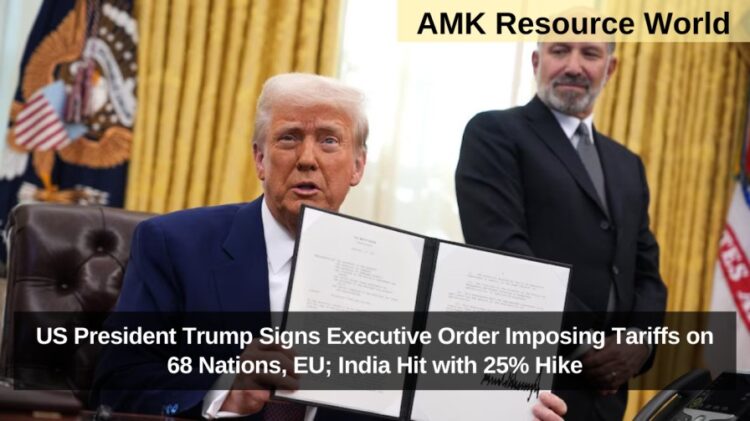
In a major escalation of his administration’s global trade agenda, U.S. President Donald Trump on Thursday signed a sweeping executive order titled “Further Modifying The Reciprocal Tariff Rates”, imposing significantly higher tariffs on 68 countries and the 27-member European Union. The order will take effect from August 7, 2025, seven days after its issuance, with tariff hikes reaching up to 41%.
Among the key trading partners affected, India has been slapped with a 25% “Reciprocal Tariff, Adjusted”, one of the highest rates in the list. The White House justified this move by pointing to India’s “obnoxious non-monetary trade barriers,” ongoing trade imbalances, and its deepening defense and energy ties with Russia.
While the original implementation date was set for August 1, the rollout was deferred to August 7 to give U.S. Customs and Border Protection (CBP) sufficient time to update internal systems. A senior official, speaking anonymously to the Associated Press, said the delay was necessary to harmonize the new tariff rates across government agencies.
The executive order is part of President Trump’s broader push to “rebalance unfair trade deficits” and reduce perceived national security risks. Countries with large trade surpluses with the U.S. or limited strategic alignment have been hit with the steepest tariff increases.

Notably high tariff rates include:
- 41% on Syria
- 40% on Laos and Myanmar
- 39% on Switzerland
- 35% on Iraq, Serbia, and Canada
In South Asia, Pakistan faces a 19% tariff, while India’s 25% rate stands as one of the highest among major U.S. trading partners.
The order outlines adjusted reciprocal tariffs on 95 countries and territories, with increases ranging from 10% to 41%. The adjustments are based on trade deficits, market access reciprocity, and strategic relationships with the U.S.
This aggressive trade action marks a sharp shift in the U.S.’s global economic strategy, signaling tougher scrutiny of traditional allies and strategic competitors alike. With the implementation looming, analysts expect heightened tensions in global trade relations and potential retaliatory measures from affected countries.