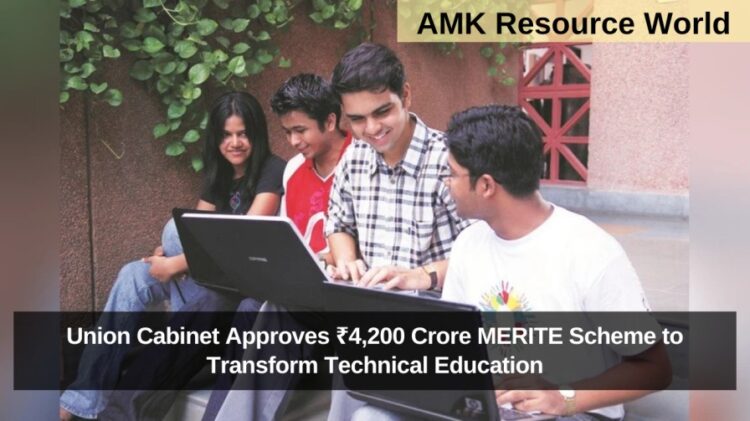
In a major push towards strengthening India’s technical education ecosystem, the Union Cabinet, chaired by Prime Minister Narendra Modi, has approved the Multidisciplinary Education and Research Improvement in Technical Education (MERITE) Scheme. The initiative, with a total outlay of ₹4,200 crore for the period 2025–26 to 2029–30, aims to bring transformative reforms to 275 technical institutions, including 175 engineering colleges and 100 polytechnic institutes, across all States and Union Territories.
The MERITE scheme is a Central Sector Scheme and will receive ₹2,100 crore as external assistance from the World Bank, ensuring strong global collaboration and the adoption of international best practices in technical education. The program is aligned with the National Education Policy (NEP) 2020, which emphasizes multidisciplinary learning, research excellence, and industry-academia linkages to meet evolving global and domestic skill demands.
The key objective of the MERITE scheme is to enhance the quality, equity, and governance of technical education in India. By focusing on innovation, inclusivity, and modernization, the scheme aims to create an enabling environment where students, faculty, and institutions can thrive. Special emphasis will be placed on providing equitable opportunities for students from underrepresented regions and communities, thereby reducing disparities in access to high-quality technical education.
Under MERITE, institutions will receive targeted support for:

- Upgrading infrastructure to meet modern learning and research requirements.
- Strengthening faculty development through training programs, exposure visits, and collaborative research.
- Promoting innovation and start-up ecosystems within campuses to encourage entrepreneurship.
- Enhancing industry partnerships for curriculum relevance, internships, and job placements.
- Improving governance frameworks to ensure transparency, accountability, and performance-based management.
One of the unique aspects of MERITE is its focus on multidisciplinary and research-driven approaches. Engineering and polytechnic institutions will be encouraged to integrate science, technology, arts, and humanities into their curriculum, preparing students for complex, real-world challenges. By fostering collaboration between disciplines, the scheme will nurture problem-solving abilities, creativity, and adaptability—key traits for the workforce of the future.
The scheme also addresses sustainability and inclusive growth by promoting eco-friendly campus practices, renewable energy adoption, and research on climate-resilient technologies. With the World Bank as a partner, MERITE will have access to global expertise in sustainable campus models, digital learning tools, and quality assurance systems.
This is not the first time India has collaborated with the World Bank to reform technical education—the Technical Education Quality Improvement Programme (TEQIP), implemented in earlier phases, demonstrated significant improvements in institutional capacity, research output, and employability. MERITE seeks to build on these successes, while expanding its scope to include polytechnics and aligning fully with NEP 2020’s vision.
The Union Cabinet’s approval marks a significant step towards equipping India’s technical institutions with the tools, resources, and governance frameworks necessary to produce globally competitive graduates. By empowering students, faculty, and institutions, MERITE promises to be a catalyst for innovation, skill development, and sustainable growth in India’s higher education landscape