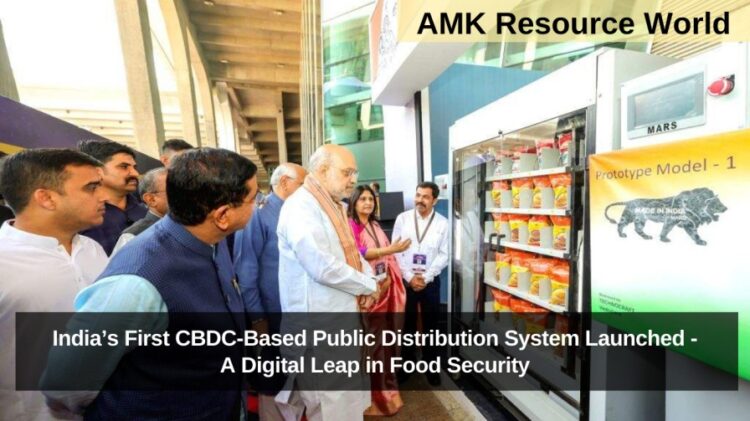
Union Home Minister Amit Shah has launched a pioneering Central Bank Digital Currency (CBDC)-based Public Distribution System (PDS) in Gandhinagar, marking a significant milestone in India’s digital governance journey. The reform integrates Digital India infrastructure with the country’s food security framework, ensuring secure, transparent, and real-time ration distribution for nearly 80 crore beneficiaries under the National Food Security Act (NFSA). This initiative aligns with Prime Minister Narendra Modi’s vision of “Minimum Government, Maximum Governance.”
The CBDC-enabled PDS modernises traditional ration distribution mechanisms by introducing secure digital transactions, reducing leakages, and preventing fraud. Beneficiaries will continue to receive 5 kg of free food grains per person, but with enhanced transparency and accountability.
How CBDC-Based PDS Works
The system leverages Central Bank Digital Currency (Digital Rupee) to facilitate secure and traceable transactions within the Public Distribution System. It integrates seamlessly with:
- Direct Benefit Transfer (DBT) mechanisms
- Aadhaar authentication systems
- Digital India financial infrastructure
- Real-time tracking dashboards
Through this framework, every transaction—from allocation to final distribution—is digitally recorded, ensuring efficiency and reducing the scope for irregularities.
Role of ‘Annapurna’ Dispensing Machines
A key technological innovation in this reform is the deployment of ‘Annapurna’ automated dispensing machines. These machines:
- Ensure accurate and standardised grain distribution
- Minimise manual intervention
- Reduce pilferage and human errors
- Enable instant verification through digital authentication
The automated model enhances speed and transparency while maintaining accountability at every stage of ration delivery.
Nationwide Expansion Plan
The Gandhinagar launch marks the beginning of a phased rollout. The government plans to expand the CBDC-based PDS system across India within 3–4 years, transforming the country’s entire food security network into a digitally empowered ecosystem.
Strengthening Food Security for 80 Crore Citizens
India’s Public Distribution System serves approximately 80 crore citizens, making it one of the largest food security programmes globally. By integrating CBDC with PDS, the government aims to:
- Eliminate ghost beneficiaries
- Prevent duplication and diversion of food grains
- Improve transparency in subsidy management
- Enhance financial inclusion
The initiative builds upon successful reforms such as Jan Dhan Yojana, Aadhaar, and Direct Benefit Transfers, forming a robust digital governance framework.
Quick Reference Summary

| Feature | Details |
| Launched By | Amit Shah |
| Location | Gandhinagar |
| System Introduced | CBDC-Based Public Distribution System |
| Key Benefit | Leak-proof, transparent ration delivery |
| Food Allocation | 5 kg free food grains per person |
| Technology Used | CBDC (Digital Rupee), DBT, Annapurna Machines |
| Coverage | Nearly 80 crore citizens |
| Expansion Plan | Nationwide rollout in 3–4 years |
Key Benefits of CBDC-Based PDS
- Transparency: Real-time tracking of food grain distribution
- Accountability: Digital audit trail for every transaction
- Efficiency: Faster and automated dispensing
- Financial Inclusion: Integration with digital banking ecosystem
- Fraud Prevention: Elimination of leakages and ghost beneficiaries
Alignment with Digital India Vision
The reform underscores India’s commitment to leveraging technology for governance reforms. The integration of CBDC into welfare schemes reflects a broader strategy of strengthening digital public infrastructure (DPI) to serve citizens efficiently.
Frequently Asked Questions (FAQs)
| What is the CBDC-based PDS launched in Gandhinagar? |
| It is a Public Distribution System integrated with Central Bank Digital Currency for secure and transparent ration distribution. |
| Who launched the initiative? |
| Union Home Minister Amit Shah launched the system in Gandhinagar. |
| How much food grain will beneficiaries receive? |
| Each eligible person will receive 5 kg of free food grains. |
| What technology supports the new PDS? |
| CBDC (Digital Rupee), Direct Benefit Transfer, Aadhaar authentication, and Annapurna dispensing machines. |
| How many citizens will benefit from this reform? |
| Nearly 80 crore beneficiaries under India’s food security scheme. |
| What are Annapurna machines? |
| Automated dispensing machines used for accurate and efficient ration distribution. |
| Will the system expand nationwide? |
| Yes, it is planned to expand across India within 3–4 years. |
| How does CBDC improve transparency? |
| It enables secure, real-time digital transactions and tracking, reducing fraud and leakages. |
The launch of the CBDC-based Public Distribution System in Gandhinagar marks a transformative step in India’s food security governance. By integrating Digital Rupee technology, automated dispensing, and real-time monitoring, the initiative strengthens transparency and accountability while serving nearly 80 crore citizens. As the government plans nationwide expansion over the next few years, this reform stands as a significant milestone in India’s digital transformation journey. For official updates, citizens are encouraged to follow government announcements and bookmark this page for future developments