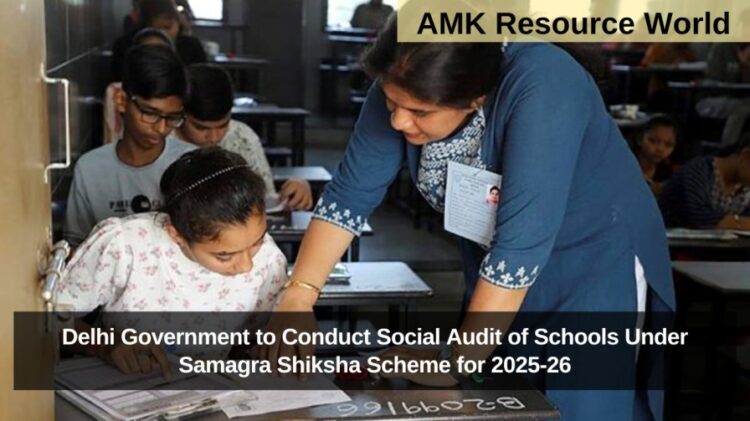
In a significant step towards ensuring accountability and quality in public education, the Delhi government has announced that it will conduct a social audit of its government schools under the Samagra Shiksha scheme for the academic year 2025-26. The audit aims to ensure that all entitlements guaranteed under the Right to Education (RTE) Act are delivered to students in a timely, transparent, and equitable manner.
According to an official circular issued by the Directorate of Education (DoE), the social audit will cover around 60% of government schools across Delhi. It will be carried out in accordance with the revised guidelines issued by the Ministry of Education, Government of India. The total budget allocated for the audit has been set at ₹3.73 crore for the upcoming academic year.
Universities and Colleges to Conduct the Audit
The Delhi government has announced that the social audit will be conducted by universities, colleges, or technical institutes with a National Assessment and Accreditation Council (NAAC) rating of B+ or above. Among these, Delhi’s State Administrative University will be given preference for leading the process.
The selected institution will be responsible for:
- Training social auditors on the guidelines and audit parameters.
- Conducting field visits to schools for on-ground assessment.
- Preparing detailed reports on compliance and performance.
- Uploading findings online to ensure transparency and accessibility.
An education department official stated, “The social audit will help identify grassroots-level issues that may not be visible through routine inspections and help the government take corrective actions promptly.”
Audit Focus: RTE Entitlements and School Infrastructure
The audit will evaluate whether students are receiving all RTE Act entitlements—including textbooks, uniforms, scholarships, and mid-day meals—without discrimination or delay. Additionally, it will review the physical condition of school infrastructure, focusing on:
- Classrooms and laboratories
- Toilets and sanitation facilities

- Drinking water and electricity supply
- Safety measures for students, particularly for girls and children with special needs
The audit will also track enrolment, attendance, and retention rates to assess whether schools are succeeding in keeping children engaged throughout the academic year.
Importantly, parents, teachers, and local community members will be encouraged to participate in the audit process to strengthen community ownership of schools and foster transparency in public education.
Promoting Safety and Accountability in Schools
Officials said that the social audit aligns with the Delhi government’s zero-tolerance policy towards any negligence related to student safety and school functioning. The findings from the audit will help the education department identify areas that require immediate attention and ensure that corrective steps are taken swiftly.
The initiative also supports the broader objectives of the National Education Policy (NEP) 2020, which calls for greater community involvement, transparency, and holistic monitoring of school systems.
About the Samagra Shiksha Scheme
Launched in 2018, Samagra Shiksha is a centrally sponsored scheme that integrates three earlier flagship programs—Sarva Shiksha Abhiyan (SSA), Rashtriya Madhyamik Shiksha Abhiyan (RMSA), and Teacher Education (TE)—to improve the quality of school education from pre-primary to Class 12. The scheme emphasizes inclusive and equitable education, teacher training, and digital learning aligned with NEP 2020.
A Step Toward Educational Excellence in Delhi
The 2025-26 social audit represents a proactive effort by the Delhi government to enhance transparency, accountability, and quality in public schools. By evaluating key parameters like infrastructure, entitlements, inclusivity, and safety, the audit is expected to strengthen public trust and ensure that every child in Delhi receives the education they deserve.