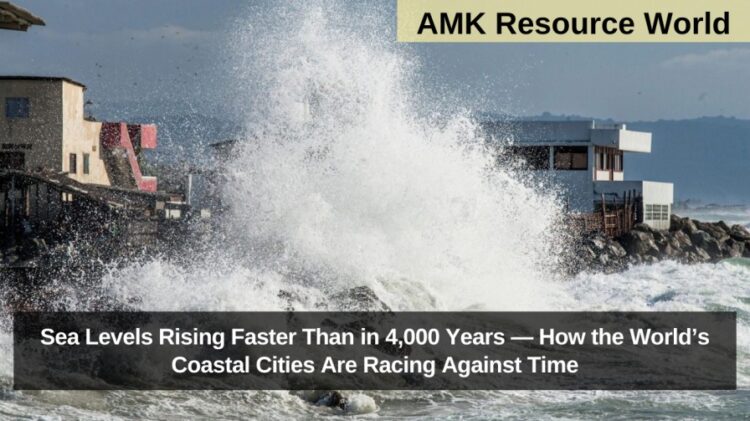
New scientific research has confirmed a chilling reality — sea levels are now rising at their fastest rate in the past 4,000 years, posing a severe threat to coastal cities around the world. According to recent studies by the Intergovernmental Panel on Climate Change (IPCC), global sea levels have risen more than 20 cm since 1900, and the pace is accelerating — currently increasing by about 4.5 mm per year.
This rapid rise endangers some of the world’s most iconic cities, including Mumbai, New York, Jakarta, and Tokyo, all of which face mounting risks of flooding, coastal erosion, and displacement. Scientists warn that unless drastic measures are taken to curb greenhouse gas emissions, sea levels could rise by up to 1 meter by the end of this century, submerging vast stretches of low-lying land and displacing millions.
The Science Behind the Rise
The primary cause of rising sea levels lies in the melting of glaciers and polar ice caps, combined with the thermal expansion of seawater as global temperatures increase. The Arctic and Antarctic regions are warming at twice the global average, leading to accelerated ice loss.
The IPCC’s Sixth Assessment Report (2023) revealed that human-induced global warming — driven by carbon dioxide, methane, and nitrous oxide emissions — is the dominant factor behind the current surge. As the planet warms, more ice melts, and seawater expands, pushing ocean levels higher each year.
Economic and Human Impact
Rising seas threaten not only coastal homes and livelihoods but also critical infrastructure, ports, and tourism economies. In India, cities like Mumbai, Chennai, and Kochi face increased flooding, saltwater intrusion, and property damage. A World Bank study estimates that by 2050, nearly 800 million people could be at risk of coastal flooding globally.
This has led to a growing population of climate refugees, forced to migrate inland as their homes and farmlands disappear beneath the rising tide. Coastal tourism, fisheries, and agriculture — pillars of many developing economies — are also suffering as changing coastlines disrupt ecosystems and livelihoods.
Countries Most at Risk
Several nations face existential threats due to sea-level rise. In South Asia, India and Bangladesh are on the front lines, with millions living in low-lying deltas vulnerable to cyclones and storm surges.

In Southeast Asia, Jakarta, Indonesia’s capital, is the world’s fastest-sinking city — subsiding by nearly 10 cm a year due to excessive groundwater extraction and rising seas. The government has already announced plans to relocate the capital to Borneo by 2045.
Meanwhile, in the Pacific Islands, nations like Tuvalu and Kiribati face the prospect of complete submersion, while the US East Coast — including cities such as New York and Miami — continues to battle worsening storm surges and flooding.
Adaptation Strategies: Building Climate Resilience
Governments worldwide are investing in climate-resilient infrastructure, including sea walls, elevated housing, and improved drainage systems. In India, states like Maharashtra are restoring mangrove forests, which act as natural barriers against storm surges.
Countries such as the Netherlands are leading by example with innovative flood defense systems and floating neighborhoods. Meanwhile, sustainable insurance and housing initiatives are emerging to protect vulnerable coastal populations.
What Individuals Can Do
While global solutions require government action, individuals can help slow the rise by adopting eco-friendly lifestyles. Reducing carbon footprints through public transport, renewable energy use, recycling, and supporting eco-conscious brands can collectively make a difference.
Planting trees, reducing plastic consumption, and conserving energy are small yet powerful steps toward a more sustainable planet.
“We Can’t Stop the Tide, But We Can Slow the Rise”
The accelerating sea-level rise is not just an environmental issue — it’s a human crisis in the making. Coastal cities, economies, and ecosystems stand on the brink, and time is running out. The science is clear: every fraction of a degree of warming matters.
By investing in climate adaptation, embracing green living, and demanding stronger climate action, we can still shape a safer future. The tide may be inevitable — but together, we can slow its rise.