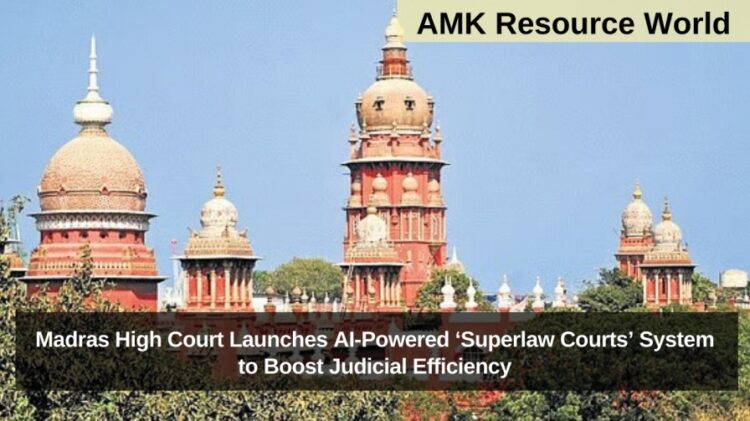
The Madras High Court has launched an innovative AI-assisted system named “Superlaw Courts”, marking a significant step toward modernising India’s justice delivery mechanism. The initiative aims to improve judicial efficiency, assist judges and legal professionals in managing extensive case records, and reduce procedural delays in court proceedings. This development highlights the increasing integration of Artificial Intelligence (AI) and digital tools within India’s legal framework.
Established in 1862, the Madras High Court is one of the three oldest High Courts in India, alongside the Bombay High Court and the Calcutta High Court. The introduction of Superlaw Courts underscores its commitment to adopting advanced technologies to strengthen transparency, speed, and accuracy in judicial processes.
What is Superlaw Courts?
The Superlaw Courts system functions as an intelligent digital record assistant designed to streamline judicial workflows. It creates a secure digital workspace where case files can be efficiently organised, accessed, and analysed.
One of its core features includes the use of Optical Character Recognition (OCR) technology, which converts scanned case documents into searchable and editable text. This enables faster retrieval of relevant information, allowing judges and lawyers to quickly reference case materials during hearings.
Key Features of the Superlaw Courts System
- AI-powered document management for handling large volumes of legal records
- Secure digital workspace for storing and accessing case files
- OCR-enabled text conversion for scanned documents
- Quick keyword search functionality for efficient case retrieval
- Reduction in paperwork and manual processing time
By digitising records and enabling smart search capabilities, the system reduces dependency on physical files and minimises administrative bottlenecks.
How Superlaw Courts Enhances Judicial Efficiency
The Indian judiciary often faces challenges such as case backlogs, document-heavy litigation, and delays in proceedings. The introduction of AI-based assistance aims to:
- Speed up document review processes
- Improve accuracy in referencing case laws and records
- Reduce clerical errors
- Enhance productivity for judges and court staff
- Strengthen overall case management efficiency
This aligns with the broader e-Courts Mission Mode Project and the Government of India’s push toward digital governance in the judicial sector.
Quick Reference Summary

| Aspect | Details |
| Initiative Name | Superlaw Courts |
| Launched By | Madras High Court |
| Technology Used | AI & OCR (Optical Character Recognition) |
| Purpose | Enhance judicial efficiency & manage case records |
| Established Year of Court | 1862 |
| Other Oldest High Courts | Bombay & Calcutta High Courts |
Significance for India’s Justice System
The deployment of AI in courts represents a major transformation in the Indian judiciary. By automating repetitive tasks and improving record accessibility, Superlaw Courts can contribute to timely justice delivery, which is a fundamental constitutional principle.
This initiative reflects a growing recognition that technology, when responsibly implemented, can serve as a powerful enabler of transparency and efficiency without replacing judicial discretion.
Frequently Asked Questions (FAQs)
| What is Superlaw Courts launched by Madras High Court? |
| It is an AI-assisted digital system designed to manage case records and improve judicial efficiency. |
| What technology does Superlaw Courts use? |
| It uses Artificial Intelligence and OCR (Optical Character Recognition) technology. |
| How does the system help judges? |
| It converts scanned documents into searchable text and enables faster retrieval of case information. |
| When was the Madras High Court established? |
| The Madras High Court was established in 1862. |
| Which other High Courts are among the oldest in India? |
| The Bombay High Court and the Calcutta High Court. |
| What is the main objective of this initiative? |
| To reduce delays and enhance efficiency in judicial proceedings. |
| Does Superlaw Courts replace judges? |
| No, it acts as an intelligent assistant to support judges and legal professionals. |
| Is this part of digital reforms in the judiciary? |
| Yes, it reflects the growing role of technology in India’s justice delivery system. |
The launch of Superlaw Courts by the Madras High Court marks a significant milestone in India’s judicial modernization journey. By leveraging AI and OCR technology, the court aims to reduce delays, streamline record management, and enhance productivity. As one of India’s oldest High Courts, this move signals a progressive shift toward a technology-driven justice system. For official updates and further announcements, visit the Madras High Court’s official website and bookmark this page for continued coverage.