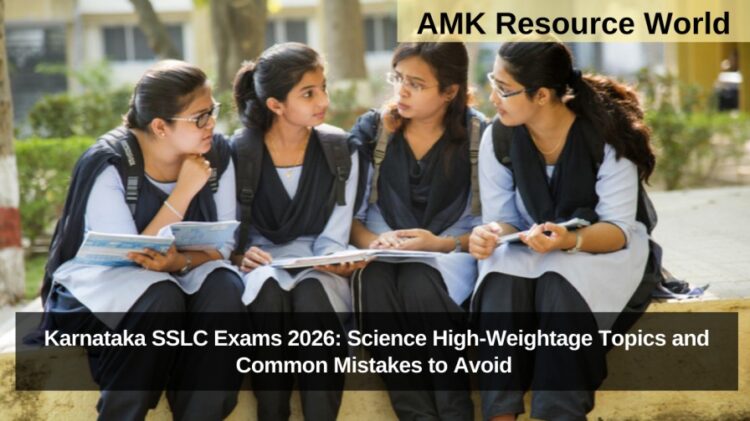
The Karnataka School Examination and Assessment Board (KSEAB) has released the chapter-wise marks distribution for SSLC Science (Subject Code: 83) for the 2025–26 academic year. The Karnataka SSLC Science Examination 2026 is one of the most important subjects for Class 10 students, as it significantly contributes to overall scores. Understanding the marks distribution helps students focus on high-weightage chapters and plan an effective preparation strategy.
According to the official document, the SSLC Science question paper carries 80 marks and includes 38 questions of different types such as 1-mark, 2-mark, 3-mark, 4-mark, and 5-mark questions, with internal choices available in some sections. The paper covers topics from Physics, Chemistry, and Biology, assessing both conceptual understanding and practical application.
HIGH-WEIGHTAGE CHAPTERS IN SSLC SCIENCE 2026
Some chapters carry higher marks weightage and are crucial for scoring well in the SSLC examination.
Carbon and Its Compounds – 8 Marks
This Chemistry chapter is one of the most important topics. Students should focus on:
- Covalent bonding
- Homologous series
- Functional groups
- Properties of carbon compounds
Questions may include chemical reactions of ethanol and ethanoic acid, hydrocarbons, and balanced chemical equations.
Life Processes – 8 Marks
This Biology chapter covers essential processes in living organisms such as:
- Nutrition
- Respiration
- Transportation
- Excretion
Students should practice diagrams of the human digestive system, plant transport systems, and respiration mechanisms.
Electricity – 8 Marks
A key Physics chapter including:
- Ohm’s Law
- Electric resistance
- Heating effect of electric current
- Electrical power
Students must practice numerical problems and formula-based questions.
Light – Reflection and Refraction – 8 Marks
Important topics include:
- Laws of reflection and refraction
- Mirror formula and lens formula
- Ray diagrams
Both diagram-based questions and numerical problems are commonly asked.
Combined Importance
The chapters Carbon and Its Compounds, Life Processes, Electricity, and Light together contribute a large portion of the marks and should be studied thoroughly.
Important 7-Mark Chapters
Some chapters carry around 7 marks, making them equally important.
- Metals and Non-metals
- How do Organisms Reproduce
These chapters often include concept-based and diagram-oriented questions.
Moderate Weightage Chapters (6 Marks)
Chapters with moderate weightage include:
- Acids, Bases and Salts
- Control and Coordination
- Magnetic Effects of Electric Current
Questions from these chapters may include definitions, explanations, and diagrams.
Other Supporting Chapters
Students should also prepare the following chapters as they contribute to the total marks:
- Chemical Reactions and Equations
- Heredity
- Human Eye and Colourful World
- Our Environment
Ignoring these topics may reduce overall scoring opportunities.
SSLC Science 2026 Question Paper Pattern
The Science question paper pattern generally includes:
| Question Type | Number of Questions |
| 1-Mark Questions | 16 |
| 2-Mark Questions | 8 |
| 3-Mark Questions | 9 |
| 4-Mark Questions | 4 |
| 5-Mark Questions | 1 |
Internal choices are provided in certain questions, allowing students to choose between alternatives within the same section.
COMMON MISTAKES STUDENTS SHOULD AVOID

Many students lose marks due to avoidable errors rather than lack of knowledge.
- Not Drawing Proper Diagrams
Science answers often require diagrams such as ray diagrams, electric circuits, and biological structures.
- Incomplete Chemical Equations
Always write balanced equations and include the states of substances.
- Ignoring Scientific Keywords
Use correct scientific terminology instead of vague explanations.
- Calculation Errors
Physics chapters require careful formula application and accurate calculations.
- Missing Labels in Diagrams
Even correct diagrams can lose marks if important parts are not labeled.
- Writing Overly Long Answers
Short-mark questions require concise and point-wise answers.
- Poor Time Management
Attempt easy questions first and avoid spending too much time on difficult ones.
Tips to Score High Marks in SSLC Science
Students aiming for distinction or centum marks should follow these strategies:
- Revise important formulas and definitions regularly
- Practice previous year question papers
- Solve model question papers for exam practice
- Focus on high-weightage chapters first
- Practice diagrams and numerical problems frequently
Consistent revision, conceptual clarity, and effective exam strategies will help students perform confidently in the Karnataka SSLC Science Exam 2026.
Quick Reference Summary
| Exam Details | Information |
| Board | Karnataka School Examination and Assessment Board (KSEAB) |
| Subject | Science (Code: 83) |
| Total Marks | 80 |
| Total Questions | 38 |
| Sections | Physics, Chemistry, Biology |
| Key High-Weightage Topics | Carbon Compounds, Life Processes, Electricity, Light |
Frequently Asked Questions (FAQs)
| What is the total mark for the SSLC Science exam 2026? |
| The SSLC Science exam carries 80 marks. |
| How many questions are there in the SSLC Science paper? |
| There are 38 questions including different mark categories. |
| Which chapters have the highest weightage in SSLC Science 2026? |
| Carbon and Its Compounds, Life Processes, Electricity, and Light each carry about 8 marks. |
| Are diagrams important in SSLC Science answers? |
| Yes, diagrams are crucial and must be properly labeled to score full marks. |
| How many 1-mark questions are asked in the Science exam? |
| Typically, there are 16 one-mark questions. |
| Is there internal choice in the SSLC Science exam? |
| Yes, some sections provide internal choices between questions. |
| What are common mistakes students make in Science exams? |
| Missing diagrams, incorrect chemical equations, and calculation errors. |
| How can students score high marks in SSLC Science? |
| By focusing on high-weightage chapters, practicing diagrams, and solving previous year papers. |
Understanding the chapter-wise marks distribution for SSLC Science 2026 allows students to focus on the most important topics and prepare strategically. By prioritizing high-weightage chapters, practicing diagrams and numericals, and avoiding common mistakes, students can significantly improve their performance. For the latest updates and official documents, students should regularly check the KSEAB official website and bookmark this page for future exam guidance, for more details CLICK HERE