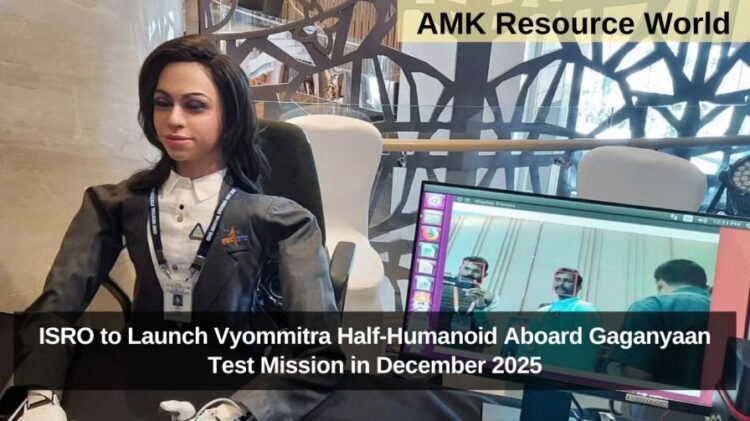
The Indian Space Research Organisation (ISRO) has announced that Vyommitra, an AI-enabled half-humanoid robot, will be part of the uncrewed test mission of the Gaganyaan project scheduled for launch by the end of December 2025. This crucial step marks India’s preparation for its ambitious human spaceflight programme, which aims to send Indian astronauts to a 400 km orbit for three days and ensure their safe return to Earth.
Vyommitra: India’s Spacefaring Half-Humanoid
Vyommitra, whose name is derived from Sanskrit meaning “space friend”, is designed to mimic human functions and interact with astronauts. As part of the Gaganyaan test mission, Vyommitra will:
- Monitor environmental conditions inside the crew module.
- Assess critical factors such as temperature, pressure, humidity, and CO2 levels.
- Relay data to mission control to simulate human presence in space.
This AI-enabled half-humanoid is expected to validate life-support systems and provide valuable feedback ahead of India’s first crewed mission.
Gaganyaan Mission: India’s Human Spaceflight Dream
The Gaganyaan project, spearheaded by ISRO, is India’s most ambitious human spaceflight programme. The mission will:

- Send astronauts into low Earth orbit at 400 km altitude.
- Sustain them for three days in space.
- Ensure their safe return via sea splashdown using an advanced crew escape system and nine parachutes.
The upcoming uncrewed test mission with Vyommitra will serve as a dress rehearsal to validate critical systems required for human survival in space.
Safety and Escape Systems
To ensure maximum safety, the mission includes:
- A crew escape system designed for rapid evacuation during emergencies.
- Nine parachutes to stabilize and safely land the crew module in the sea.
- Environmental monitoring tools to replicate and analyze conditions astronauts will face.
These systems will be extensively tested in the uncrewed mission before human flights are attempted.
Collaboration with National Agencies
The Gaganyaan project is a multi-agency collaboration involving:
- ISRO – Designing and executing the mission.
- Indian Air Force – Training future astronauts.
- Indian Navy – Handling recovery operations after sea splashdown.
- DRDO (Defence Research and Development Organisation) – Developing life-support and critical safety systems.
- Other scientific institutions contributing expertise in medicine, materials, and aerospace technologies.
Strategic Importance of the Mission
The success of the Gaganyaan programme will place India among the elite group of nations—USA, Russia, and China—that have developed independent human spaceflight capabilities. Beyond national pride, the mission will:
- Strengthen India’s position in the global space sector.
- Open avenues for future international collaborations.
- Inspire advancements in AI, robotics, and space medicine.
The announcement by ISRO Chairman V. Narayanan that Vyommitra will fly on the Gaganyaan uncrewed test mission in December 2025 marks a historic milestone for India’s space programme. By testing life-support systems, safety mechanisms, and environmental conditions, the mission will lay the foundation for India’s first human spaceflight. As ISRO, the Indian Air Force, Navy, DRDO, and other agencies join forces, India moves closer to making history in human space exploration.