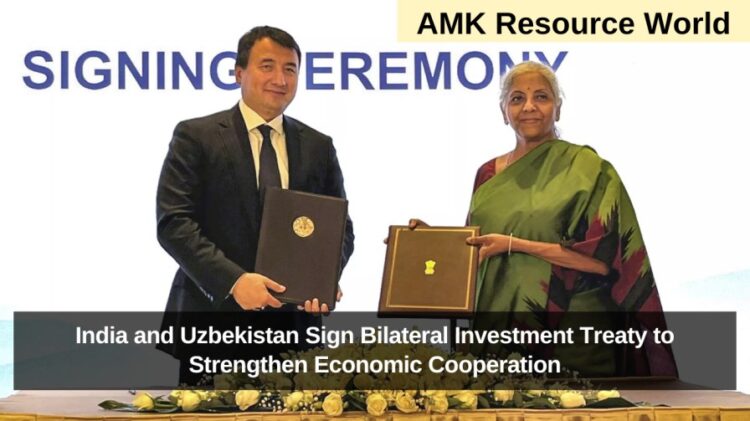
In a significant step towards strengthening economic ties, India and Uzbekistan have signed a Bilateral Investment Treaty (BIT) aimed at boosting investor confidence and expanding trade relations. The treaty was formalized in Tashkent, where Indian Finance Minister Nirmala Sitharaman and Uzbekistan’s Deputy Prime Minister Khodjayev Jamshid Abdukhakimovich represented their respective nations.
The India–Uzbekistan BIT is designed to promote cross-border investments by ensuring investor protection, transparency, and fair treatment. It provides investors from both countries with the assurance of a minimum standard of treatment, protection against discriminatory practices, and a clear mechanism for dispute resolution through arbitration.
Key Objectives of the India–Uzbekistan BIT
The Bilateral Investment Treaty between India and Uzbekistan is expected to:
- Boost Investor Confidence: By offering legal safeguards, the treaty will encourage Indian companies to invest in Uzbekistan’s growing sectors such as renewable energy, infrastructure, pharmaceuticals, and IT services. Similarly, Uzbek investors will find new opportunities in India’s manufacturing, agriculture, and textile industries.
- Enhance Economic Cooperation: The agreement is aligned with India’s vision of expanding trade with Central Asia, while Uzbekistan gains a strong partner in South Asia.
- Facilitate Arbitration for Disputes: The BIT includes provisions for neutral arbitration, giving investors a reliable avenue to resolve disputes outside the domestic courts of either nation.
- Ensure Non-Discrimination: Investors from both countries will be treated on par with domestic investors, eliminating barriers and promoting fair competition.
Strategic Importance of the Treaty
The India–Uzbekistan Bilateral Investment Treaty 2025 comes at a time when both nations are seeking to diversify trade and strengthen geopolitical partnerships. Uzbekistan, located in the heart of Central Asia, serves as a strategic hub for connectivity projects under India’s Connect Central Asia Policy.

For India, the treaty enhances its presence in the region while supporting initiatives such as the International North-South Transport Corridor (INSTC) and the Chabahar Port project, which aim to improve trade connectivity with Central Asian economies.
On the other hand, Uzbekistan benefits from access to India’s vast consumer market, advanced IT and pharmaceutical sectors, and expertise in renewable energy.
Positive Impact on Trade and Investment
The BIT between India and Uzbekistan is expected to significantly increase Foreign Direct Investment (FDI) flows in both directions. Indian firms have shown keen interest in Uzbekistan’s solar energy projects, food processing units, and textile manufacturing, while Uzbek enterprises are exploring opportunities in India’s automobile and agritech industries.
Moreover, the treaty is set to improve the ease of doing business, creating a more predictable and secure environment for investors. This aligns with India’s broader policy of signing modern BITs that balance investor rights with the host country’s regulatory powers.
The signing of the India–Uzbekistan Bilateral Investment Treaty marks a historic milestone in the economic partnership between the two nations. By assuring investor protection, non-discrimination, and effective dispute resolution, the treaty lays the foundation for stronger trade, investment, and cultural ties.
As India and Uzbekistan continue to expand their cooperation, the BIT will serve as a cornerstone for sustainable economic growth, opening new avenues for businesses and strengthening the strategic partnership between South Asia and Central Asia.