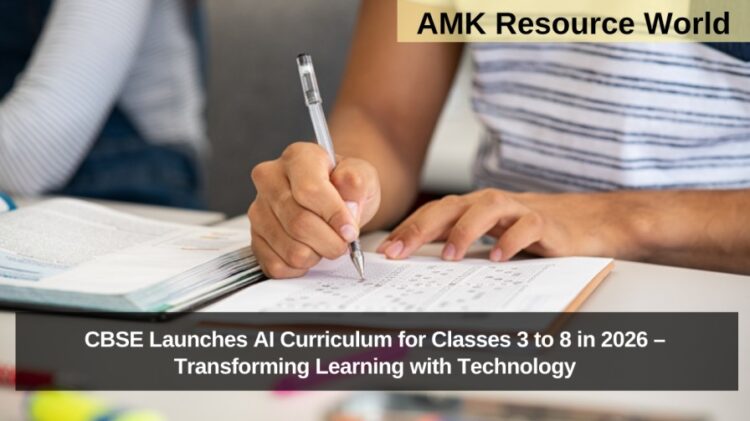
The Ministry of Education has introduced a groundbreaking AI curriculum for Classes 3 to 8 under the CBSE syllabus, marking a transformative step in India’s education system. The initiative, launched on April 1, 2026, integrates Artificial Intelligence (AI) and computational thinking into the mathematics curriculum, aiming to move students beyond rote memorisation toward critical thinking, problem-solving, and design-based learning. This reform is highly relevant for students, parents, and educators across India and globally, including CBSE-affiliated schools abroad.
Objective of the AI Curriculum
The core goal of the new curriculum is to:
- Replace rote learning with analytical and critical thinking
- Develop computational and problem-solving skills from an early age
- Prepare students for a technology-driven future
- Promote innovation and creativity in classrooms
The programme is mandatory for all students from Classes 3 to 8, ensuring uniform adoption across CBSE schools.
Key Features of CBSE AI Curriculum 2026
- Integration of AI concepts within existing NCERT Maths and TWAU (The World Around Us) textbooks
- Focus on computational thinking and logical reasoning
- Introduction of hands-on, activity-based learning methods
- Development of student and teacher handbooks for effective implementation
- Curriculum designed by a specialised AI committee chaired by IIT Professor Karthik Raman
- Full academic validation by NCERT for quality and consistency
Future Expansion Plans
The Ministry has confirmed that the AI curriculum will be:
- Extended to Classes 9 and 10 in the next academic year
- Further strengthened with advanced modules in data science, machine learning basics, and ethical AI use
This phased implementation ensures students progressively build advanced digital skills.
Philosophy Behind the Initiative
Union Education Minister Dharmendra Pradhan highlighted the guiding principle:
“AI for education, AI in education.”
This reflects a dual approach:
- Using AI tools to enhance teaching methods
- Teaching AI concepts to students as a core competency
The initiative aligns with India’s broader vision of becoming a global leader in digital and technological innovation.
Role of NCERT and Academic Experts
The curriculum has been rigorously developed and reviewed:
- Created by a dedicated AI expert committee
- Reviewed through multiple consultations (9 meetings)
- Approved by NCERT to ensure pedagogical alignment and academic credibility
This ensures strong E-A-T (Expertise, Authoritativeness, Trustworthiness) signals for academic content.
Quick Reference Summary

| Feature | Details |
| Launched By | Ministry of Education, India |
| Board | CBSE |
| Classes Covered | 3 to 8 |
| Launch Date | April 1, 2026 |
| Focus Areas | AI, Computational Thinking, Critical Thinking |
| Integration | NCERT Maths & TWAU Books |
| Future Expansion | Classes 9 & 10 (next year) |
| Validation | NCERT Approved |
Benefits for Students
- Builds future-ready digital skills
- Encourages logical reasoning and innovation
- Enhances problem-solving capabilities
- Reduces dependency on memorisation-based learning
- Prepares students for AI-driven careers and higher education
Impact on Teachers and Schools
Teachers will receive structured guidance through handbooks and training modules, enabling them to:
- Deliver interactive and engaging lessons
- Integrate AI tools into teaching practices
- Foster a collaborative and inquiry-based classroom environment
Schools will play a key role in ensuring smooth implementation of the curriculum.
Frequently Asked Questions (FAQs)
| What is the CBSE AI curriculum 2026? |
| It is a new syllabus integrating AI and computational thinking into maths for Classes 3 to 8. |
| When was the AI curriculum launched? |
| It was launched on April 1, 2026. |
| Is the AI curriculum compulsory? |
| Yes, it is mandatory for all students from Classes 3 to 8. |
| Will AI be introduced for higher classes? |
| Yes, it will be extended to Classes 9 and 10 next year. |
| Who developed the curriculum? |
| A specialised AI committee led by IIT Professor Karthik Raman. |
| Which books include AI concepts? |
| NCERT Maths and TWAU (The World Around Us) books. |
| What is the main goal of this curriculum? |
| To shift from rote learning to critical thinking and problem-solving. |
| Is the curriculum approved by NCERT? |
| Yes, it has been reviewed and approved by NCERT. |
The launch of the CBSE AI Curriculum 2026 marks a significant milestone in India’s education reform journey. By embedding artificial intelligence and computational thinking into early education, the government aims to equip students with future-ready skills essential in a digital world. Students, parents, and educators are encouraged to stay updated through official CBSE and NCERT platforms and bookmark this page for the latest updates on curriculum changes and academic policies