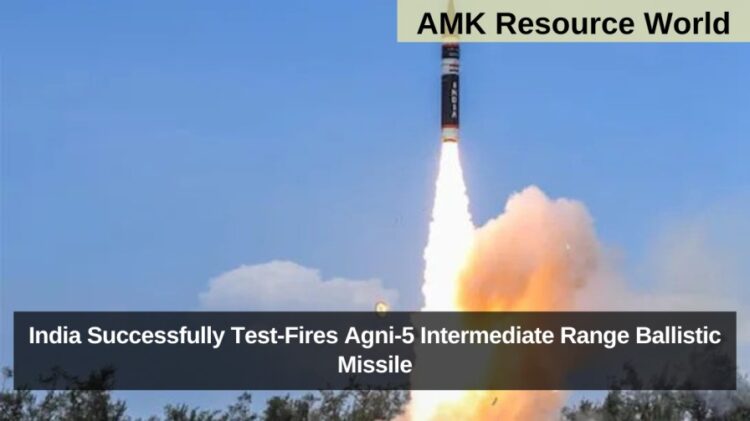
India successfully test-fired the Agni-5 Intermediate Range Ballistic Missile (IRBM) from the Integrated Test Range at Chandipur, Odisha. Conducted under the Strategic Forces Command (SFC), the test validated the missile’s operational readiness and reaffirmed India’s commitment to maintaining a credible nuclear deterrent.
Key Features of Agni-5 Missile
The Agni-5 missile represents the cutting edge of India’s indigenous missile development program. Designed and developed by the Defence Research and Development Organisation (DRDO), it is a three-stage, solid-fuelled, canisterised missile that provides enhanced mobility, quick deployment, and secure storage.
- Range: Over 5,000 km, placing it in the category of Intermediate Range Ballistic Missiles (IRBM).
- Payload: Capable of carrying both nuclear and conventional warheads with high accuracy.
- Canisterised System: Ensures rapid launch capability, better survivability, and ease of transportation by road or rail.
- Advanced Navigation: Incorporates state-of-the-art guidance and control systems for precision targeting.
Strengthening India’s Nuclear Triad
The successful test-firing of the Agni-5 IRBM strengthens India’s nuclear triad, which includes the ability to launch nuclear weapons from land, sea, and air platforms. With its extended range, the missile provides India with credible deterrence across Asia and beyond.
By reinforcing its No First Use (NFU) policy, India has once again demonstrated its doctrine of maintaining nuclear weapons solely for defensive and deterrent purposes. The test assures that India’s nuclear arsenal remains credible, effective, and reliable against potential threats.
Strategic Significance of the Agni-5 Test

The test is a major milestone in India’s defense preparedness. Some of its strategic implications include:
- Regional Security Balance – The missile’s range covers vast geographies, enhancing India’s ability to deter hostile powers and maintain strategic stability.
- Operational Readiness – Conducted under the Strategic Forces Command, the test validated India’s ability to deploy the missile in real-world conditions.
- Boost to Indigenous Defense – The Agni-5 is a product of India’s indigenous defense research, showcasing self-reliance in advanced missile technology.
- Global Recognition – The test signals India’s capability as a responsible nuclear power adhering to NFU principles, while maintaining a robust deterrent.
Agni Missile Series: India’s Strategic Backbone
The Agni missile family forms the backbone of India’s strategic arsenal:
- Agni-I & II: Short to medium range, covering regional deterrence.
- Agni-III & IV: Intermediate range with enhanced payload capacity.
- Agni-5: Longest-range tested system, crossing the 5,000 km mark, extending India’s deterrence capabilities significantly.
The successful Agni-5 test on August 20, 2025 marks a defining moment in India’s defense preparedness. By integrating advanced technology, canisterised mobility, and long-range strike capability, the missile enhances India’s strategic deterrence and bolsters its position as a responsible nuclear power.
With its reaffirmed commitment to No First Use (NFU) and a strengthened nuclear triad, India has demonstrated both its defense capabilities and its resolve to maintain peace and stability in the region through credible deterrence.