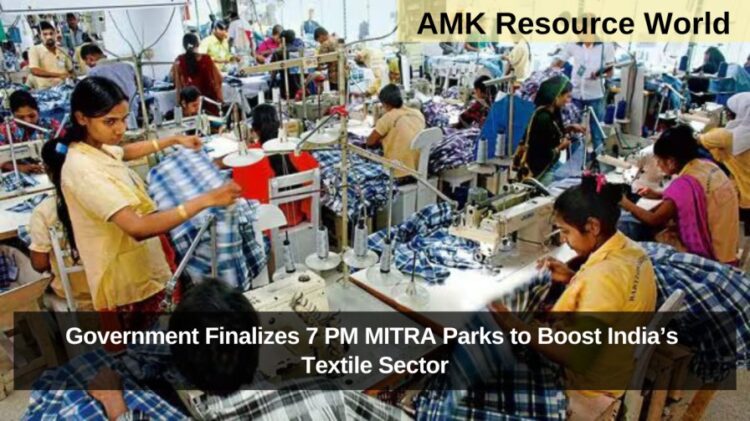
In a significant push to transform India into a global textile manufacturing hub, the Government has finalized the locations for seven PM Mega Integrated Textile Region and Apparel (PM MITRA) Parks across the country. The mega parks will be established in Virudhunagar (Tamil Nadu), Warangal (Telangana), Navsari (Gujarat), Kalaburagi (Karnataka), Dhar (Madhya Pradesh), Lucknow (Uttar Pradesh), and Amravati (Maharashtra).
The scheme, with an outlay of ₹4,445 crore till 2027-28, aims to attract ₹70,000 crore in investments and create about 20 lakh direct and indirect jobs. The PM MITRA initiative is designed to integrate the entire textile value chain—from spinning, weaving, and processing to garment manufacturing—within state-of-the-art industrial complexes. This approach is expected to reduce logistics costs, improve efficiency, and boost the global competitiveness of Indian textiles.
Union Textiles Minister Piyush Goyal has described the PM MITRA Parks as a “game-changer” for the industry, stating that the initiative will help position India as a preferred sourcing destination for global apparel brands. The parks will be developed in partnership with state governments, offering world-class infrastructure, plug-and-play manufacturing units, and environmentally sustainable facilities.

Complementing the PM MITRA initiative is the ‘Samarth’ scheme, which focuses on capacity building in the textile sector. Implemented nationwide, Samarth provides demand-driven, placement-oriented skill training programmes, excluding spinning and weaving, to meet industry requirements. In Haryana alone, 26 implementing partners are currently operating 80 active training centres to deliver entry-level training as well as upskilling and reskilling programs for workers.
The Government is also extending financial support to Export Promotion Councils (EPCs) and trade bodies engaged in textile and garment exports. This assistance enables Indian exporters to participate in trade fairs, exhibitions, and buyer-seller meets at both domestic and international levels. These platforms are crucial for connecting Indian manufacturers with global buyers, exploring new markets, and strengthening the country’s position in the global textile supply chain.
In addition, the National Technical Textiles Mission (NTTM), launched with a budget of ₹1,480 crore for the period 2020-21 to 2025-26, is being actively implemented to boost the technical textile sector across India, including in Haryana. The mission focuses on research, innovation, and the promotion of high-performance textiles used in industries such as healthcare, infrastructure, agriculture, and defence. Technical textiles represent one of the fastest-growing segments of the global textile market, and the mission aims to ensure that India captures a larger share of this high-value segment.
The combination of PM MITRA Parks, the Samarth skill development scheme, export promotion support, and the NTTM is expected to create a synergistic growth environment for India’s textile and apparel industry. With integrated infrastructure, a skilled workforce, and a focus on innovation, India is set to strengthen its role as a global textile powerhouse, generating large-scale employment and driving economic growth in the coming years.