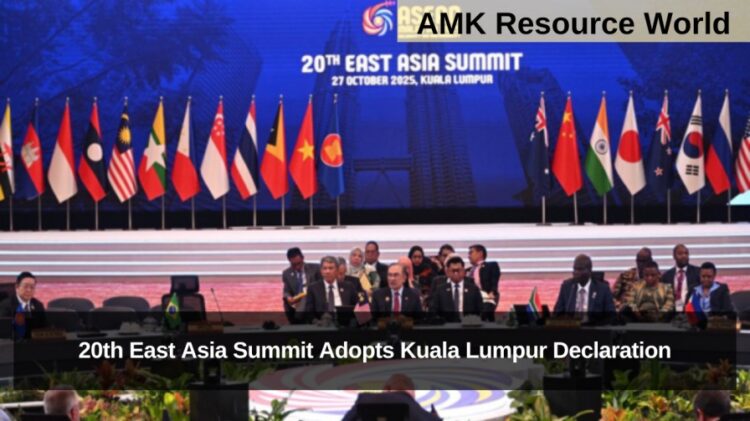
The 20th East Asia Summit (EAS) held in Kuala Lumpur, Malaysia, marked a crucial moment in regional diplomacy as leaders adopted the Kuala Lumpur Declaration, reaffirming their strong commitment to peace, stability, and security in the Indo-Pacific region. The summit brought together 18 participating countries, including major powers such as India, China, the United States, Japan, Russia, Australia, South Korea, and ASEAN member nations, highlighting the EAS as a vital platform for strategic dialogue and cooperation.
The Kuala Lumpur Declaration emphasizes the importance of strengthening partnerships and promoting strategic trust among the member states. Leaders reiterated that transparent, responsible, and rules-based behaviour is essential for maintaining regional order, especially amid evolving geopolitical challenges and rising tensions in the South China Sea and the Indo-Pacific. The declaration encourages peaceful conflict resolution in accordance with international law, including the United Nations Charter and the UNCLOS framework.
A key focus of the declaration is enhanced information exchange and collaboration on regional development, security initiatives, and disaster management efforts. The region is frequently affected by natural calamities such as earthquakes, typhoons, and floods, making humanitarian cooperation and disaster-resilient infrastructure critical for sustainable development. Member countries agreed to share best practices, strengthen early-warning systems, and ensure timely response mechanisms to protect lives and reduce economic disruptions.
The summit also addressed the evolving regional architecture, highlighting the importance of ASEAN’s central role in shaping the future of the East Asia region. Leaders discussed efforts to bolster economic integration, promote connectivity, support digital transformation, and ensure resilient supply chains to withstand global uncertainties. As the world continues to recover from the impacts of the COVID-19 pandemic, the declaration calls for joint initiatives to foster innovation-driven and inclusive growth across the region.

Security cooperation remained a central theme. The declaration underscores the need for counterterrorism collaboration, maritime security partnerships, and the prevention of cyber threats. Participating states acknowledged the importance of maintaining freedom of navigation and overflight, ensuring that the Indo-Pacific remains a zone of peace and prosperity. The EAS members also reiterated the importance of denuclearization efforts and addressing transnational crimes.
Moreover, the 20th East Asia Summit highlighted the significance of people-to-people connectivity, education, and cultural exchanges. Leaders expressed confidence that enhanced cooperation in education, technology, and green development would contribute to a more sustainable future.
The Kuala Lumpur Declaration demonstrates the united resolve of EAS nations to work collectively toward a secure, stable, and thriving East Asia. As geopolitical shifts continue to reshape global dynamics, the summit reaffirmed the importance of dialogue and cooperation in maintaining harmony and ensuring that regional growth benefits all.