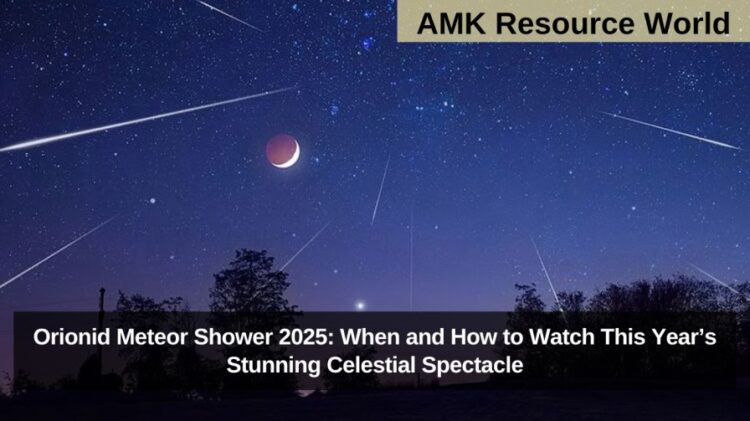
Every year, the night sky delivers breathtaking astronomical events that capture the imagination of skywatchers. Among these wonders, meteor showers are some of the most magical, painting the sky with glowing streaks of light — nature’s very own cosmic fireworks. As autumn 2025 unfolds, stargazers around the world can look forward to one of the season’s most anticipated celestial events: the Orionid Meteor Shower 2025.
What Is the Orionid Meteor Shower?
The Orionid Meteor Shower occurs every October when Earth passes through the debris trail left behind by Halley’s Comet — one of the most famous comets in history. As the comet travels through the solar system, it leaves behind a stream of dust and tiny particles. When these fragments collide with Earth’s atmosphere, they burn up instantly, producing bright streaks of light known as meteors.
Interestingly, Halley’s Comet also causes another meteor shower — the Eta Aquariids, which appears each May when Earth crosses the comet’s outbound trail. The Orionids, on the other hand, are the result of Earth moving through the comet’s inbound path, giving skywatchers a second annual opportunity to witness its remnants.
When to Watch the Orionid Meteor Shower 2025
The Orionid Meteor Shower 2025 will peak from Tuesday, October 21, to Thursday, October 23, according to the American Meteor Society (AMS). This year’s viewing conditions are expected to be exceptionally good, as the peak coincides with moonless nights, allowing darker skies and higher visibility.

Under ideal conditions — away from city lights and pollution — skywatchers can expect to see around 15 to 20 meteors per hour, with occasional bursts producing even more. Although enhanced activity is not predicted this year, the Orionids are renowned for their bright, fast-moving meteors that often leave long-lasting trails.
Where to Watch the Orionid Meteor Shower
For those in the United States, the best viewing window will be between 1 AM and dawn during the peak nights. The meteor shower’s radiant point — the spot in the sky from which meteors appear to originate — is near the constellation Orion, which rises in the eastern sky after 10 PM.
To get the best experience, observers should face east or southeast, ideally from a dark, open location with minimal light pollution. The meteors can appear anywhere in the sky, so it’s best to have a wide field of view.
Viewing from Other Parts of the World
The Orionids are visible across the globe, including in the Southern Hemisphere, though the radiant appears lower in the northern sky there, resulting in slightly fewer visible meteors. Skywatchers in India, Australia, Europe, and South America will still have excellent opportunities to enjoy the display, especially during the early morning hours.
Alongside the Orionids, observers might also spot occasional meteors from the Taurids, Geminids, or Leo Minor showers, as well as random sporadic meteors that streak across the sky year-round.
Tips for Watching the Orionid Meteor Shower 2025
- Find a dark location away from city lights for optimal visibility.
- Lie back comfortably on a blanket or reclining chair for an unobstructed view.
- Allow your eyes 20–30 minutes to adjust to the darkness.
- Avoid using your phone or bright lights, as they can ruin night vision.
- Look about halfway up from the horizon rather than directly overhead — this often offers the best view of meteors.
A Celestial Show Worth Staying Up For
The Orionid Meteor Shower 2025 promises to be one of the most enchanting sky events of the year, offering a front-row seat to a natural light show created by the legendary Halley’s Comet. Under clear, dark skies, it’s a perfect opportunity for stargazers, families, and astronomy enthusiasts to connect with the cosmos and marvel at the beauty of our universe.