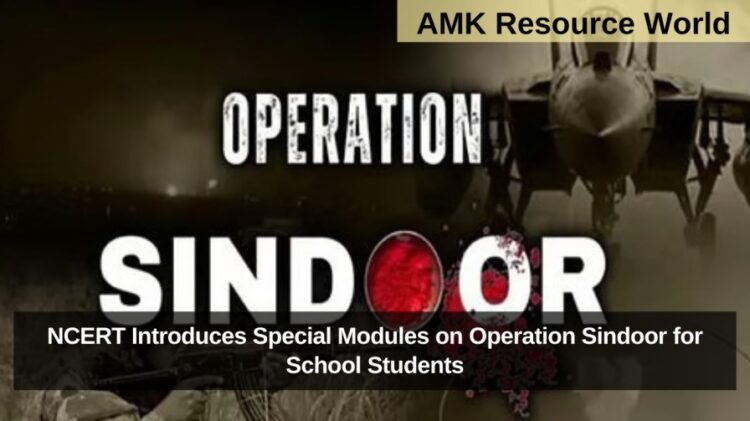
The National Council for Education Research and Training (NCERT) has launched two new special modules on Operation Sindoor, a military operation described as a “triumph of bravery, strategy, and innovation.” These modules aim to educate students about India’s military strength, strategic responses, and the nation’s fight against terrorism.
The first module, “Operation Sindoor—A Saga of Valour,” is designed for Classes 3 to 8 under the preparatory and middle stage curriculum. The second, “Operation Sindoor—A Mission of Honour and Bravery,” is tailored for Classes 9 to 12 in the secondary stage. Both modules are supplementary learning resources available in English and Hindi, and they will be taught through projects, posters, discussions, and debates, rather than being part of the standard textbooks.
Content of the Operation Sindoor Modules
The NCERT modules focus on India’s Operation Sindoor, which was carried out in response to the Pahalgam terror attack of April 22, where 26 people were killed. While Pakistan denied involvement, the modules assert that the attack was carried out under “direct orders” from Pakistan’s military and political leadership.
The modules also highlight the role of the Resistance Front (TRF), a Lashkar-e-Taiba proxy group, and the involvement of Pakistan’s Inter-Services Intelligence (ISI) in planning the terror strike.
In addition, the materials provide strategic insights into the operation, including maps of targeted sites, photographs of destroyed Pakistani drones, and details of India’s air defence systems such as the S-400 missile system, which played a role in intercepting and neutralising enemy aircraft and drones.
National and Local Response

The secondary school module goes beyond military strategy to showcase the social and emotional response of the Indian population. It notes that following the Pahalgam attack, there were candlelight marches across India. Communities, including Muslims in Hyderabad, Lucknow, and Bhopal, denounced the attack by wearing black armbands. In Kashmir, shopkeepers closed their businesses in protest, and border villages demanded strong retaliation.
The NCERT module stresses that the Kashmiri people “stood up and spoke against terrorists,” challenging stereotypes and showing that the local population supports peace and unity.
Historical Context and ‘Make in India’
The modules also place Operation Sindoor in the larger framework of India’s military history, citing earlier conflicts such as the wars of 1947, 1965, 1971, and 1999, along with the 2019 Balakot airstrikes. This helps students understand how India has consistently responded to external aggression and terrorism with strength and resilience.
Another key highlight is the emphasis on the ‘Make in India’ initiative in defence. Defence Minister Rajnath Singh is quoted in the module, stating: “The operation proved India can break through any enemy defence using what we have made ourselves.” This not only reinforces national pride but also encourages students to appreciate indigenous defence technology.
Through Operation Sindoor modules, NCERT seeks to inspire patriotism and awareness among students while providing insights into India’s military preparedness, strategic decision-making, and unity in diversity. These modules aim to strengthen national consciousness, ensuring that young learners understand the importance of bravery, innovation, and collective responsibility in safeguarding the nation.