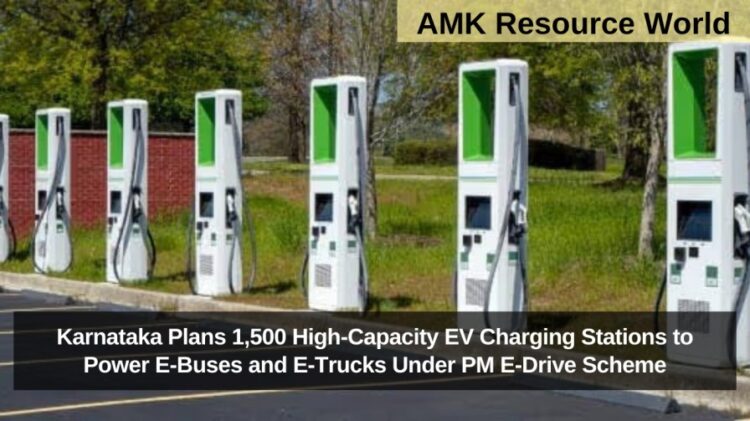
Riding on the momentum of India’s electric vehicle (EV) revolution, Karnataka is taking the next big leap toward electrifying heavy-duty transport, including electric buses and trucks. Building on its leadership in electric two- and three-wheeler adoption, the state government is preparing to submit a detailed proposal under the Centre’s PM E-Drive scheme to establish 1,500 high-capacity EV charging stations across Karnataka.
Each charging station will support fast chargers ranging from 60kW to 240kW, capable of powering large electric vehicles for long-distance operations. The initiative marks the next phase of Karnataka’s EV infrastructure expansion, reflecting the state’s growing commitment to green mobility and sustainable transportation.
Karnataka Leads India in EV Infrastructure
According to the India EV Infrastructure Report (2025), Karnataka already hosts 6,097 public charging stations, the highest in India, out of the country’s total 29,000 EV charging points as of August 2025. With this new plan, the state aims to cement its status as the EV capital of India, particularly by extending electrification beyond private vehicles to include public and commercial fleets.
As part of the proposal, the Energy Department of Karnataka will identify strategic locations — including bus depots, national and state highways, freight corridors, and logistics hubs — for setting up these high-capacity chargers.
Officials said the financial burden on the state exchequer will be minimal due to the central subsidy component under the PM E-Drive scheme, which covers 80% to 100% of project costs depending on the equipment type.
PM E-Drive Scheme: Boosting India’s EV Ecosystem
Launched in October 2024, the PM E-Drive scheme aims to accelerate electric mobility adoption, strengthen EV charging networks, and promote domestic manufacturing of EV components. Karnataka’s proposal aligns closely with the scheme’s objectives, including its plans to deploy e-buses across state transport corporations.

Shivashankara, Managing Director of BESCOM (Bangalore Electricity Supply Company), confirmed that a formal proposal will soon be submitted to the Union Ministry of Heavy Industries. BESCOM has been designated as the nodal agency for implementing EV charging infrastructure across the state.
“The scheme provides 100% subsidy for upstream components such as transmission lines, transformers, and conductors, while other equipment will receive up to 70% subsidy,” Shivashankara explained.
Earlier this year, the state also held discussions with Union Minister for Heavy Industries and Steel H.D. Kumaraswamy, seeking central assistance and an allocation of 4,500 electric buses for Karnataka’s public transport corporations under the PM E-Drive scheme.
Fast-Charging Revolution Across Karnataka
As part of the electrification drive, Karnataka is also upgrading existing slow chargers to fast-charging systems to reduce wait times and improve user convenience.
“Slow chargers take around 3–4 hours to fully charge a vehicle, while fast chargers can do it within 30–45 minutes. To improve accessibility, we’ve begun converting slow-charging booths into fast-charging stations,” said Shivashankara.
Out of 209 slow-charging stations under BESCOM’s jurisdiction, 184 have already been upgraded. The conversion cost is approximately ₹5 lakh for two-wheeler chargers and ₹8 lakh for four-wheeler chargers, he added.
BESCOM has also partnered with major oil companies — IOCL, HPCL, and BPCL — to set up about 400 EV charging points at petrol stations across Karnataka, expanding access for both urban and highway EV users.
Karnataka’s Green Transport Vision
Karnataka’s latest initiative is a transformational step toward zero-emission transport, complementing its Electric Vehicle and Energy Storage Policy. By focusing on heavy-duty EVs and fast-charging infrastructure, the state aims to significantly cut carbon emissions, boost local EV manufacturing, and create thousands of green jobs.
With 1,500 new high-capacity EV charging stations planned under the PM E-Drive scheme, Karnataka is not only reinforcing its position as a national leader in EV infrastructure but also paving the way for a cleaner, more sustainable transport future.