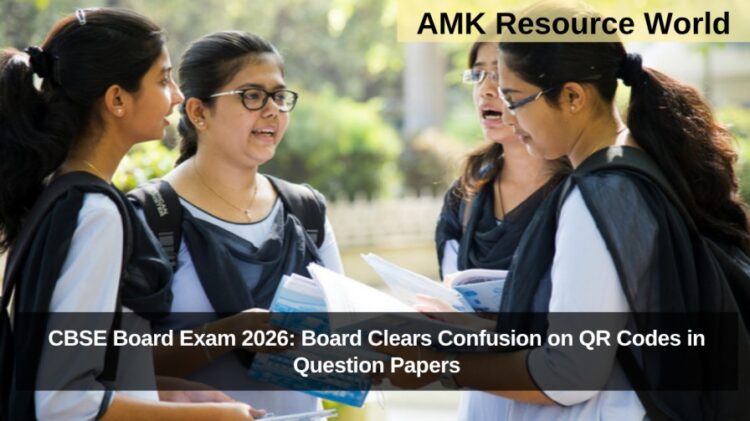
The Central Board of Secondary Education (CBSE) has issued an important advisory addressing the misinterpretation of QR codes printed on CBSE Board Exam 2026 question papers. The official notice, available on cbse.gov.in, aims to clarify confusion among students, parents, and educators regarding the purpose and functionality of these QR codes.
The Board has emphasized that QR codes in CBSE question papers are not internet hyperlinks and should not be interpreted as clickable or scannable links leading to external websites. This clarification is crucial for students preparing for the CBSE Class 10 and Class 12 Board Exams 2026, especially amid the spread of misleading information on social media platforms.
Purpose of QR Codes in CBSE Question Papers
According to CBSE, the QR codes are part of internal examination systems designed to ensure:
- Authentication of question papers
- Tracking and monitoring of exam materials
- Maintaining examination integrity and security
When scanned, these QR codes do not redirect to any website. Instead, they simply display predefined encoded text used internally by CBSE systems.
Why Misinterpretation Happened
The Board noted that some individuals attempted to:
- Extract or manually type QR-related strings into search engines
- Interpret encoded data as web links
This resulted in irrelevant or misleading search results, sometimes showing unrelated names or entities. CBSE clarified that such outputs are algorithm-driven search engine results and have no connection with CBSE or its examination process.
CBSE Warning Against Misinformation
CBSE has raised concerns about mischievous propaganda and misinformation circulating online. The Board strongly advised all stakeholders to:
- Avoid sharing unverified claims related to QR codes
- Refrain from spreading speculative interpretations
- Verify all information through official CBSE communications
Guidelines for Students, Parents, and Educators

CBSE has issued the following key instructions:
- Do not treat QR codes as external links or digital shortcuts
- Avoid relying on social media rumors or unofficial explanations
- Refer only to cbse.gov.in for authentic updates
- Exercise caution before sharing any exam-related content online
Quick Reference Summary
| Aspect | Details |
| Issued By | Central Board of Secondary Education (CBSE) |
| Topic | QR Code Misinterpretation in Exam Papers |
| Function of QR Code | Authentication & tracking (internal use) |
| Do QR Codes Open Links? | No |
| Risk Identified | Misinformation & misleading online claims |
| Official Website | cbse.gov.in |
Why This Advisory Matters
With board exams being a critical milestone, misinformation can cause unnecessary panic and confusion among students. By clarifying the role of QR codes, CBSE aims to maintain transparency, trust, and exam integrity. Students should focus on preparation and rely only on verified academic sources.
Frequently Asked Questions (FAQs)
| Are QR codes in CBSE question papers clickable links? |
| No, they are not hyperlinks and do not open any websites. |
| What is the purpose of QR codes in CBSE exams? |
| They are used for internal authentication, tracking, and maintaining exam integrity. |
| Why do QR codes show unrelated results online? |
| Because search engines generate algorithm-based results unrelated to CBSE. |
| Should students scan QR codes during exams? |
| No, scanning them has no relevance for students during the exam. |
| Where can I verify CBSE exam-related information? |
| Only through the official website cbse.gov.in. |
| Has CBSE warned against misinformation? |
| Yes, CBSE has advised all stakeholders not to share unverified claims. |
| Can QR codes affect exam results? |
| No, they are only for internal administrative purposes. |
| Who should follow this advisory? |
| Students, parents, educators, and media platforms. |
The CBSE advisory on QR codes in Board Exam 2026 question papers serves as a crucial clarification to prevent confusion and misinformation. Students and stakeholders must rely only on official CBSE sources and avoid spreading unverified content. For accurate updates and notifications, visit cbse.gov.in and bookmark this page for reliable exam-related information, for more details CLICK HERE