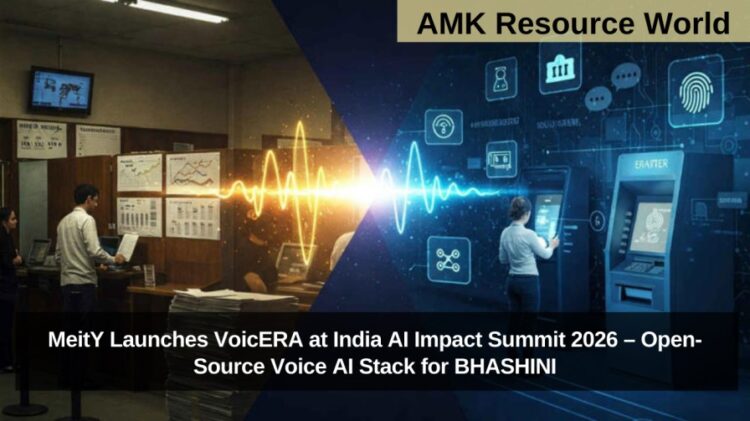
The Ministry of Electronics and Information Technology (MeitY) has unveiled VoicERA, an open-source, end-to-end Voice AI stack, at the India AI Impact Summit 2026. Developed under the Digital India BHASHINI Division of the Digital India Corporation, the initiative marks a major advancement in strengthening India’s Digital Public Infrastructure (DPI) for multilingual voice technologies. The launch signals the government’s continued push toward inclusive, population-scale AI systems designed for India’s linguistic diversity.
VoicERA has been deployed directly on the BHASHINI National Language Infrastructure, establishing a national execution layer for multilingual Voice and Language AI systems. This move positions voice as a primary interface for citizen-centric digital services.
National Execution Layer for Multilingual Voice AI
VoicERA is built as an open, modular, and interoperable framework that supports both cloud deployment and on-premise installations. It enables secure and scalable implementation across:
- Government departments
- Research institutions
- Academic ecosystems
- Innovation and startup networks
By reducing duplication of effort and preventing vendor lock-in, VoicERA accelerates the development of voice-enabled digital services in multiple Indian languages. Its architecture ensures secure deployment while maintaining scalability for large-scale citizen engagement.
Collaboration and Institutional Backing
The initiative was spearheaded by Amitabh Nag, Chief Executive Officer of the Digital India BHASHINI Division, in collaboration with:
- EkStep Foundation
- Centre for Open Source Software (COSS), IIIT Bengaluru
- AI4Bharat
This collaboration unites public institutions, academic expertise, and non-profit innovation networks to build sovereign capabilities in language and voice AI technologies. Experts have described VoicERA as a digital public good, enabling execution-ready deployment without requiring institutions to rebuild entire AI technology stacks from scratch.
Expanding BHASHINI’s Capabilities
Until now, BHASHINI primarily focused on translation and text-based language tools. With the introduction of VoicERA, its scope now expands to include:
- Real-time speech systems
- Conversational AI platforms
- Multilingual telephony services at scale
Government departments can now deploy voice-enabled citizen services in areas such as:
- Agriculture advisories
- Education support systems
- Livelihood and employment services
- Grievance redressal platforms
- Public scheme discovery mechanisms
This advancement makes voice a natural interface for public service delivery, particularly in linguistically diverse and digitally underserved regions of India.
Boost to Sovereign and Inclusive AI

The launch of VoicERA strengthens India’s commitment to sovereign AI development and inclusive digital governance. By integrating voice technologies into the nation’s Digital Public Infrastructure, the government aims to ensure equitable access to services across geographies and communities.
The framework supports:
- Secure AI deployment
- Scalable architecture
- Interoperable systems
- Population-scale language innovation
With VoicERA, India moves closer to becoming a global leader in multilingual Voice AI and public digital infrastructure innovation.
Quick Reference Summary
| Feature | Details |
| Initiative Name | VoicERA |
| Launched By | Ministry of Electronics & IT (MeitY) |
| Platform Base | BHASHINI National Language Infrastructure |
| Launch Event | India AI Impact Summit 2026 |
| Nature | Open-source, modular, interoperable Voice AI stack |
| Collaborators | EkStep, IIIT Bengaluru (COSS), AI4Bharat |
| Deployment Mode | Cloud & On-premise |
| Use Cases | Agriculture, education, grievance redressal, public services |
Frequently Asked Questions (FAQs)
| What is VoicERA? |
| VoicERA is an open-source, end-to-end Voice AI stack launched by MeitY to support multilingual voice technologies. |
| Where was VoicERA launched? |
| It was unveiled at the India AI Impact Summit 2026. |
| Which platform hosts VoicERA? |
| VoicERA is deployed on the BHASHINI National Language Infrastructure. |
| Who led the initiative? |
| The Digital India BHASHINI Division under MeitY, led by Amitabh Nag. |
| What makes VoicERA significant? |
| It creates a national execution layer for multilingual voice AI and avoids vendor lock-in. |
| Which institutions collaborated on the project? |
| EkStep Foundation, IIIT Bengaluru’s Centre for Open Source Software, and AI4Bharat. |
| What services can VoicERA enable? |
| Agriculture advisories, education support, grievance redressal, livelihood services, and more. |
| Why is VoicERA important for inclusive governance? |
| It enables voice-based access to digital services in multiple Indian languages, improving accessibility. |
The launch of VoicERA by MeitY marks a transformative step in India’s Digital Public Infrastructure, expanding BHASHINI into real-time multilingual Voice AI systems. By promoting open, secure, and interoperable frameworks, the government reinforces its commitment to sovereign AI capabilities and inclusive digital governance. For official updates and technical details, visit the Digital India and MeitY portals, and bookmark this page for future developments in India’s AI ecosystem.