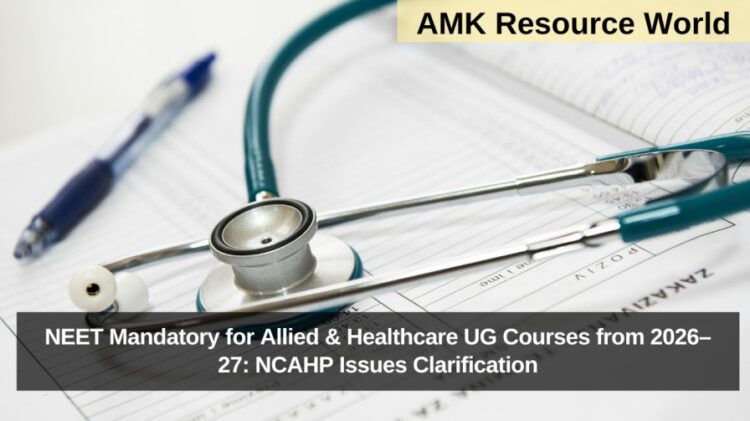
The National Commission for Allied and Healthcare Professions (NCAHP) has officially clarified that the National Eligibility-cum-Entrance Test (NEET) will be mandatory for admission to several undergraduate (UG) allied and healthcare programmes starting from the academic year 2026–27. Students aspiring to purse key Allied & Healthcare courses after Class 12 must now appear for NEET, in addition to meeting programme-specific eligibility criteria. This decision marks a major reform aimed at standardising entry requirements across the growing Allied and Healthcare sector in India and abroad.
The Commission confirmed that 13 new curricula for UG and PG Allied & Healthcare programmes have already been notified and will be implemented from the upcoming academic session. More curricula will be released soon. As stated by NCAHP, the eligibility requirements mentioned in these curricula are backed by the NCAHP Act, 2021.
NEET to Become Entry Requirement for Allied Health Courses
According to the official statement, most notified curricula for Allied & Healthcare courses have included NEET as a mandatory entry criterion, in line with the NCAHP Act. Admissions using these updated curricula will begin from the 2026–27 academic year. This brings Allied & Healthcare programmes closer to the regulatory standards followed in MBBS, BDS and other major medical courses.
Background: ‘Paramedical’ to Be Replaced with ‘Allied & Healthcare’
Earlier in July, NCAHP officially recommended discontinuing the term “paramedical”, proposing that all healthcare-related professions be recognised uniformly under Allied & Healthcare. This change modernises terminology and aligns India’s healthcare education with global standards.
Key Reforms Introduced in 2025
The Ministry of Health and Family Welfare (MoHFW), in partnership with NCAHP, introduced landmark reforms for the sector this year, including:
- Use of “Dr” title for Physiotherapy graduates, with a ‘PT’ suffix (e.g., Dr. Name, PT)
- Expansion of national standard curricula across Allied & Healthcare disciplines
- Introduction of uniform entry criteria aligned with NEET
These reforms aim to elevate the academic credibility, professional recognition, and career pathways of Allied and Healthcare practitioners.
Courses That Will Require NEET from 2026–27
From the upcoming academic year, students must qualify NEET for admission to major UG Allied & Healthcare programmes including:
- Physiotherapy (BPT)
- Optometry
- Nutrition & Dietetics
- Dialysis Technology
- Therapy-based programmes (various specialisations)
NCAHP may add more programmes as upcoming curricula are released.
Why NEET Has Been Made Mandatory

NEET aims to:
- Ensure uniform national standards in healthcare education
- Improve the quality of intake across disciplines
- Provide merit-based admissions in a rapidly expanding sector
- Align Allied & Healthcare courses with the eligibility model used for MBBS & BDS
Quick Reference Summary
| Aspect | Details |
| Authority | National Commission for Allied & Healthcare Professions (NCAHP) |
| New Rule | NEET mandatory for UG Allied & Healthcare admissions |
| Effective From | Academic Year 2026–27 |
| Courses Affected | Physiotherapy, Optometry, Nutrition & Dietetics, Dialysis Technology, Therapy courses |
| Based On | NCAHP Act, 2021 |
| Curricula Notified | 13 UG & PG Allied & Healthcare programmes |
Impact on Students
Students planning careers in Allied Health Sciences must now:
- Prepare for NEET starting 2026,
- Meet additional programme-specific academic requirements,
- Follow updated admission guidelines issued by NCAHP, colleges, and universities.
The move enhances transparency and standardisation across institutions offering these programmes.
Frequently Asked Questions (FAQs)
| Is NEET now mandatory for Allied & Healthcare UG admissions? |
| Yes, NEET will be required from the 2026–27 academic year. |
| Which courses will need NEET qualification? |
| Physiotherapy, optometry, nutrition & dietetics, dialysis technology, and therapy programmes. |
| Why has NCAHP introduced NEET for these courses? |
| To ensure national standards, improve quality of intake, and maintain regulatory uniformity. |
| When will the new rules come into effect? |
| From the 2026–27 academic session. |
| How many curricula have been notified? |
| Thirteen UG and PG Allied & Healthcare curricula so far. |
| What term replaces “paramedical”? |
| “Allied & Healthcare” is now the official terminology. |
| Can Physiotherapy graduates use ‘Dr’? |
| Yes, with a mandatory ‘PT’ suffix. |
| Will more courses shift to NEET-based admissions? |
| Yes, NCAHP plans to notify additional curricula soon. |
The NCAHP directive making NEET mandatory for UG Allied & Healthcare courses from 2026–27 represents a significant shift in India’s healthcare education framework. With updated curricula, national standards, and expanded professional recognition, the sector is moving toward greater academic rigour and global alignment. Students should begin preparing early for NEET and track official updates from NCAHP and the Ministry of Health. Bookmark this page for timely updates and visit the official NCAHP portal for the latest notifications.