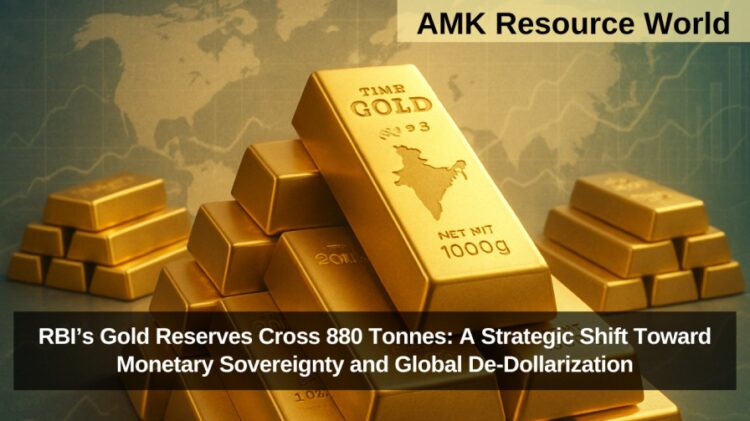
The Reserve Bank of India (RBI) has made a historic leap in strengthening its financial security — its gold reserves crossed 880 metric tonnes, valued at approximately $95 billion as of late September 2025. By October 10, 2025, these holdings surged past $100 billion, fueled by a 65% rally in international gold prices. This expansion marks India’s growing focus on gold as a safe-haven asset and a strategic tool for monetary diversification, echoing a powerful global trend where central banks are repositioning gold at the heart of their reserve management policies.
RBI’s Gold Surge: A Strategic Reserve Management Shift
As of September 26, 2025, the RBI’s gold holdings stood at 880.18 metric tonnes, representing a massive valuation of $95 billion. By October, the figure jumped to $102.36 billion, with gold now accounting for 14.7% of India’s total foreign exchange reserves — the highest proportion since 1996–97.
Although physical gold purchases slowed in 2025 — only 0.6 metric tonnes were added in the six months leading up to September — the explosive rise in global prices propelled the total value of holdings. The RBI added 54.13 metric tonnes during FY 2024–25, demonstrating a long-term commitment to strengthening reserve resilience amid global uncertainty.
This move aligns India with a worldwide central bank gold-buying spree, led by countries such as China, Turkey, and Poland, as they diversify away from the U.S. dollar to hedge against geopolitical risks, currency volatility, and the weaponization of sanctions.
Global Trend: Gold’s Role in a Changing Monetary Order
The RBI’s strategic accumulation reflects a paradigm shift in global reserve management. Central banks are moving away from the dollar and increasing exposure to gold due to:
- De-dollarization pressures: Countries are reducing dependence on U.S. dollar assets to mitigate exposure to sanctions and political risk.
- Inflation concerns: Persistent global inflation and rising sovereign debt make gold a vital hedge against currency devaluation.
- Safe-haven appeal: In a world marked by conflict and uncertainty, gold remains politically neutral and financially secure.
The World Gold Council (WGC) and the International Monetary Fund (IMF) report a steady increase in official gold holdings globally, with central banks purchasing an estimated 1,100 tonnes in 2024, setting the stage for a record-breaking 2025.
MARKET IMPACT: WINNERS AND BENEFICIARIES

Gold Mining Companies
Rising gold demand and prices have directly benefited mining giants such as Newmont Corporation (NYSE: NEM), Barrick Gold (NYSE: GOLD), and Agnico Eagle Mines (NYSE: AEM). These firms enjoy higher profit margins, stronger cash flows, and greater investor interest. Royalty-based companies like Wheaton Precious Metals (NYSE: WPM) and Franco-Nevada (NYSE: FNV) are also seeing gains as they earn from production revenues without bearing operational risks.
Financial Institutions
Banks and financial firms facilitating gold storage, trading, and gold-backed investment products are witnessing growing demand. Institutions like Goldman Sachs, JPMorgan, and UOB Bank are expanding gold-related services, while logistics leaders like Brink’s Global Services and Loomis International handle increased physical movement.
In India, gold loan companies such as Muthoot Finance and Manappuram Finance benefit significantly, as higher prices increase collateral value and loan volumes.
Investors and ETFs
Exchange-Traded Funds (ETFs) tracking gold have seen renewed inflows as investors hedge portfolios against inflation and dollar weakness. Consistent central bank buying provides a price floor for gold, making it a stable long-term investment.
The Big Picture: De-Dollarization, Inflation, and Geopolitics
The RBI’s gold accumulation forms part of a global de-dollarization movement. The dollar’s share of global reserves has dropped below 58%, while gold’s share has nearly doubled to 20%.
The trend is further accelerated by inflationary pressures, monetary easing policies, and Federal Reserve rate cuts initiated in September 2025. These conditions reduce the opportunity cost of holding gold, strengthening its appeal as a non-yielding but stable asset.
Additionally, the Basel III reclassification of physical gold as a Tier 1 asset in July 2025 — giving it a zero-risk weighting — has spurred institutional and bank-level gold accumulation. This regulatory change legitimizes gold as a core financial asset, not just a commodity.
Outlook: Gold’s Future in the Global Financial System
The global trajectory of central bank gold purchases suggests a sustained, structural realignment. Analysts project continued buying of 600–800 tonnes annually through 2026, driven by geopolitical uncertainty, inflation fears, and financial diversification.
Optimistic projections indicate that if central bank purchases continue at this pace, gold could reach $4,000 per ounce by mid-2026 and possibly exceed $5,000 by 2030.
However, challenges include price volatility, supply constraints in mining, and the high entry point for new investors. Still, gold’s safe-haven strength and institutional demand will likely sustain its long-term upward trajectory.
The Bottom Line: Gold’s Enduring Power
The RBI’s gold accumulation strategy marks a critical inflection point in global finance. It reflects India’s determination to strengthen monetary autonomy and align with a broader shift toward de-dollarization and inflation hedging.
As gold’s role expands from a traditional commodity to a strategic monetary anchor, investors, policymakers, and financial institutions are taking note.
In an era defined by economic fragmentation, geopolitical uncertainty, and currency realignment, gold has once again reclaimed its place at the center of the global financial system — not just as a symbol of wealth, but as the ultimate store of value and pillar of stability.