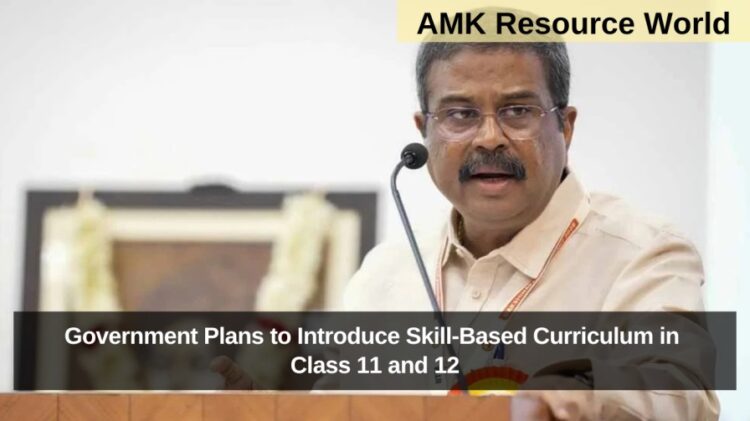
The Union Government is actively working to incorporate skill-based learning in the curriculum of Class 11 and 12, in line with the recommendations of the National Education Policy (NEP) 2020, Union Education Minister Dharmendra Pradhan.
Speaking at the Dakshinapatha Summit 2025 at IIT Madras, the minister stressed the need for a paradigm shift in learning methodology to prepare India’s youth for the future. “We are on the job to introduce skill-based curriculum in Class 11 and 12,” Pradhan said, highlighting that the education system must evolve beyond being merely certificate and degree-oriented.
NEP 2020 and the Push for Skill-Based Education
The National Education Policy 2020 has been designed to transform India’s education system, with one of its core recommendations being skill-based education. Traditionally, schools focused on academic streams such as science, commerce, and humanities, but the government is now preparing to integrate skilling as a formal part of the curriculum.
Pradhan emphasized that skill-based learning, which was previously optional and selective, will now become mandatory from Class 6 onwards. For students in Class 11 and 12, this means learning alongside mainstream subjects. “For example, a student may study Mathematics, a language, and Computer Language writing – that is coding. They may also learn drone technology, artificial intelligence, and emerging fields. It is a new era,” he explained.
Making Students Competent for the Future

Pradhan highlighted Prime Minister Narendra Modi’s vision that India needs not just degrees and certificates, but also competent and skilled graduates who can contribute to nation-building. “We have to train and align our youngsters with the new curriculum structure,” he said.
He also shared examples from IIT Madras, where students have already been engaging in innovative projects and startups. Some students who qualified for JEE Advanced but could not enter IIT due to their sports commitments are now able to pursue their passion under the progressive policy of NEP 2020, which encourages inclusion of talents from sports, arts, and music.
Language, Startups, and Viksit Bharat Vision
Pradhan also underscored the importance of languages in global collaboration. “If an Indian company needs to work with an Israeli firm, it must learn Hebrew. Similarly, while English and Mandarin are important, I would also like to learn Tamil, because Tamil Nadu is a vibrant thinking society,” he said.
The minister also interacted with students enrolled in IIT Madras under the ‘IITM for All’ initiative, which offers the four-year online BS Data Science programme to students from rural and underprivileged backgrounds. This initiative, he said, is “making IIT education accessible, fulfilling aspirations, and turning dreams into reality.”
Highlighting India’s booming startup ecosystem, Pradhan pointed out that over 1.75 lakh startups have been registered in the country, and many founders have become job creators instead of job seekers. With IITs competing globally, skill-based education will ensure that India remains a leader in innovation.
The NEP 2020 is a visionary document aimed at achieving the Centre’s goal of Viksit Bharat by 2047. By formally introducing skill-based learning in Class 11 and 12, the government is laying the foundation for an education system that blends knowledge with employability. With emerging skills in AI, coding, and drone technology becoming part of the curriculum, India’s students will be better equipped to meet global challenges and drive the nation’s growth in the coming decades