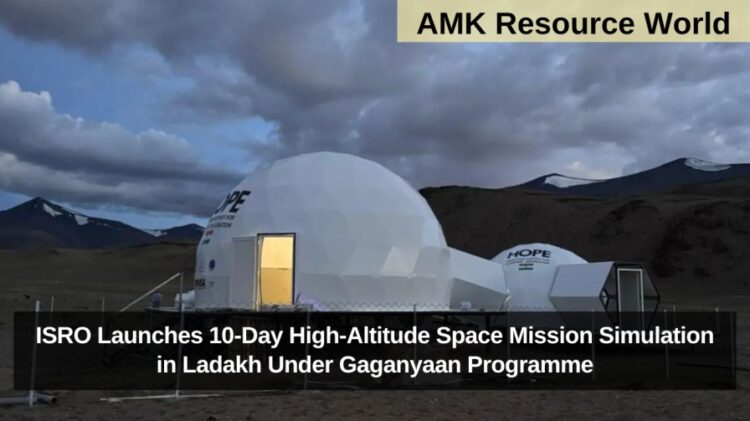
In a significant step toward preparing for India’s first human spaceflight, the Indian Space Research Organisation (ISRO), in collaboration with private space firm Protoplanet, has launched a 10-day high-altitude space mission simulation under the Gaganyaan programme. The mission began at the newly inaugurated HOPE (Himalayan Outpost for Planetary Exploration) facility, located at a breathtaking altitude of 14,000 feet in Ladakh.
The simulation aims to study the psychological and physiological effects of isolation, high-altitude stress, and extreme cold—conditions that closely resemble those experienced in outer space. The insights from this experiment will significantly contribute to India’s understanding of human endurance and adaptability in space-like environments, enhancing crew preparedness for the Gaganyaan mission.
Out of 135 applicants, two candidates—Rahul Mogalapalli and Yaman Akot—were carefully selected for the simulation. Both individuals underwent rigorous evaluation to meet the physical and mental demands required for participation in such a challenging and pioneering mission. Over the course of 10 days, they will live in conditions that mimic the confined, isolated, and extreme environments faced by astronauts aboard the International Space Station (ISS).
The simulation includes a structured schedule aligned with real spaceflight routines, featuring biological sampling, mental health monitoring, and task-based evaluations to measure alertness, cognitive performance, and emotional resilience. Daily activities, including communication protocols and emergency simulations, are designed to replicate those carried out by astronauts in space.

The HOPE facility, situated in the remote Himalayan terrain, is uniquely equipped to simulate planetary habitats and space station environments. The location was chosen specifically for its harsh climatic conditions, making it an ideal testing ground for studying human adaptability and the psychological impact of prolonged isolation in extreme environments.
The mission also has broader implications beyond the Gaganyaan programme. Data gathered from the study will benefit planetary exploration planning, particularly for future missions to the Moon and Mars, where astronauts will face similar challenges of isolation, high radiation exposure, and extreme temperature variations.
ISRO’s decision to collaborate with Protoplanet reflects India’s growing openness to public-private partnerships in space research and exploration. This collaboration is seen as a model for how startups and private firms can complement national space objectives by providing innovative platforms and testing grounds.
The simulation mission in Ladakh represents a major stride in ISRO’s ambitious Gaganyaan programme, which seeks to send Indian astronauts into low Earth orbit aboard an indigenously developed spacecraft. Scheduled for launch in the coming years, Gaganyaan will mark India’s entry into the elite group of nations capable of independent human spaceflight.
As the 10-day simulation progresses, scientists, psychologists, and medical experts will continue to monitor and analyze the outcomes, paving the way for safer and more efficient human missions in space. With this high-altitude experiment, ISRO underscores its commitment to building a robust, human-centric space programme, making India a key player in the future of space exploration.