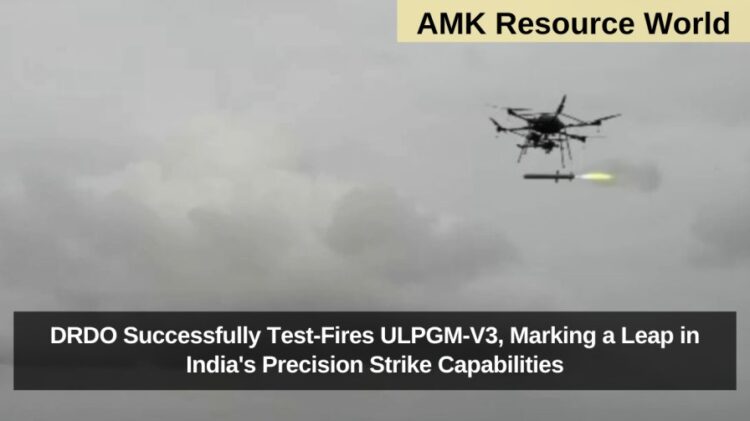
In a significant advancement for India’s defence technology, the Defence Research and Development Organisation (DRDO) has successfully test-fired the UAV-Launched Precision Guided Missile (ULPGM) Version 3 (ULM-ER) at a testing range in Kurnool, Andhra Pradesh. This marks a major milestone in India’s quest for drone-launched precision strike capabilities, strengthening the country’s tactical edge in modern warfare.
Weighing 12.5 kg, the ULPGM-V3 is powered by a dual-thrust solid motor, enabling extended range and high-speed engagement. What sets this advanced missile apart is its infrared imaging seeker, which allows for day and night precision targeting in diverse terrains and operational environments. The system is also equipped with a two-way datalink, allowing operators to update target information mid-flight or abort missions if necessary, thus ensuring higher mission flexibility and accuracy.
The missile supports multiple warhead configurations, including anti-tank, anti-personnel, and blast-fragmentation options, making it suitable for a range of mission profiles. This versatility enhances the combat readiness of India’s drone fleet, especially in border surveillance and counter-insurgency operations.

The development of the ULPGM has been a collaborative effort, with the DRDO leading the project in close partnership with MSMEs, defence startups, and major industry players such as Adani Defence and Bharat Dynamics Limited (BDL). The inclusive development model reflects the government’s push for Aatmanirbhar Bharat (self-reliant India), aiming to reduce dependence on foreign defence imports and promote indigenous innovation.
The ULPGM programme features three variants, each tailored to specific operational needs. The newly tested V3, or ULM-ER (Extended Range), is the most advanced variant, offering greater reach and enhanced targeting features. It is designed to be launched from various UAV platforms, including India’s long-endurance drones and rotary-wing UAVs.
Defence analysts see this success as a game-changer in India’s evolving military doctrine, enabling stand-off precision strikes with reduced risk to human life. The integration of ULPGM systems into India’s armed forces will significantly bolster surveillance-to-strike timelines, a critical factor in modern combat scenarios.
In essence, the successful test of ULPGM-V3 is not just a technological feat but a strong affirmation of India’s growing indigenous defence capabilities and its commitment to becoming a global leader in next-generation warfare systems.