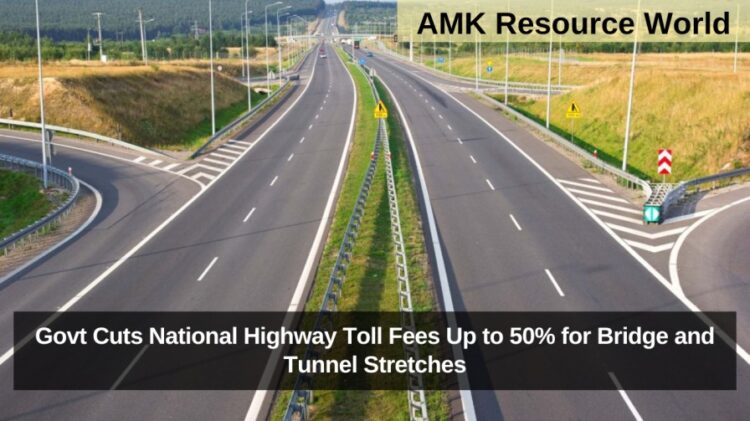
In a major move aimed at reducing travel costs for motorists, the Government of India has amended the National Highways Fee (Determination of Rates and Collection) Rules, 2008. The revision introduces a new formula that significantly lowers toll charges—by as much as 50%—on national highway stretches featuring costly structural components such as tunnels, bridges, flyovers, or elevated roads.
Previously, toll rates on such stretches were calculated by multiplying the actual length of the structure by a factor of ten. This was done to compensate for the higher construction costs of these complex structures. However, the steep user charges that resulted often became a financial burden for regular commuters. The amended rule, which revises the formula for toll calculation, marks a shift toward a more user-friendly approach.

Under the revised norms, the toll on highway sections with major structures will now be calculated based on the lesser of two values: ten times the actual length of the structures or five times the total length of the entire highway section. This change ensures that motorists are not overcharged for short stretches of road simply because they contain long bridges or tunnels.
The new rule will especially benefit drivers who regularly use highways with extensive structural features, as their toll burden is expected to be reduced considerably. For instance, in regions with long flyovers or tunnels, travelers previously faced significantly higher tolls despite using a relatively short segment of the highway. Now, the revised method will ensure more equitable tolling, aligning fees more closely with actual road usage.
This initiative is seen as part of the government’s broader agenda to improve transportation affordability and infrastructure access. By rationalizing toll rates, the Ministry of Road Transport and Highways aims to encourage more usage of national highways, reduce congestion on alternate routes, and promote smoother traffic flow.
The revision is expected to come as a welcome relief to daily commuters, logistics operators, and long-distance travelers alike. Overall, this rule change is a strategic and people-friendly reform that balances infrastructure cost recovery with public convenience—ultimately enhancing the efficiency of India’s growing highway network.