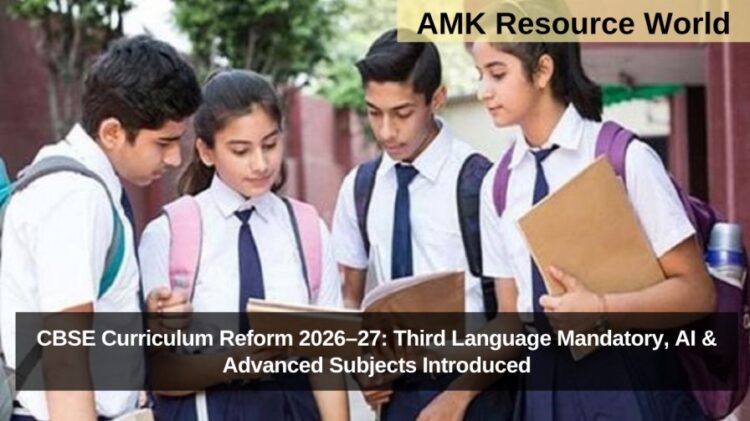
The Central Board of Secondary Education (CBSE) has announced major curriculum and assessment reforms aligned with the National Education Policy (NEP) 2020 and the National Curriculum Framework for School Education (NCFSE) 2023. Starting from the 2026–27 academic session, CBSE will introduce a mandatory third language from Class 6, advanced-level subject options, and integration of Artificial Intelligence (AI) and Computational Thinking (CT) into the formal assessment system. These changes will gradually roll out, with the first major impact visible in the 2028 board examinations.
CBSE Chairperson Rahul Singh clarified that the framework is evolving and will be refined based on feedback from schools and stakeholders.
CBSE Three-Language Policy (R1, R2, R3)
A major highlight of the reform is the three-language formula, structured as:
- R1, R2, R3 languages
- At least two languages must be Indian languages
Key Changes
- Third language mandatory from Class 6 (2026–27)
- Gradually extended till Class 10 by 2030–31
- From 2028 board exams, students must appear in at least two languages
- CBSE now offers 44 languages, including Santhali, Maithili, Dogri, and Konkani
This policy aims to promote multilingual proficiency and cultural diversity among students across India and globally.
Advanced-Level Mathematics & Science (Class 9 Onwards)
From the 2026–27 session, students entering Class 9 will get an option to study advanced-level Mathematics and Science.
How It Works
- All students study the standard curriculum
- Advanced learners can opt for an additional 1-hour exam (25 marks)
- Focus on analytical and higher-order thinking skills
From 2028 Board Exams
- Students can choose up to two advanced-level subjects
- Scores above 50% will be separately mentioned in marksheets
- Marks will not be added to the overall aggregate
CBSE plans to extend this model to Social Science in future phases.
AI & Computational Thinking in CBSE Exams
CBSE is introducing future-ready skills into the curriculum:
Implementation Plan
- Classes 3–8: Integrated Computational Thinking (CT)
- Classes 9–12: Structured modules from 2027–28
- By 2029: CT & AI will be compulsory in board assessments
This shift ensures students are prepared for a technology-driven world, focusing on problem-solving and algorithmic thinking.
New Assessment System (Internal + Board Exams)
CBSE is moving towards a hybrid assessment model:
Internal Assessment Subjects
- Art Education
- Physical Education & Well-being
- Interdisciplinary subjects
Hybrid Model (Internal + Board Exam)
- Vocational subjects (from 2027–28 onwards)
New Subjects Introduced
- “Individuals in Society” (Class 9)
- “Environmental Education” (Class 10)
These will be competency-based and internally assessed.
CBSE Transition Timeline
- 2026–27: Implementation begins (Class 6 & 9 entry level)
- 2027 Exams: No major changes
- 2028 Board Exams: First major structural changes
- 2029 onwards: AI & CT formal evaluation
- 2030–31: Full implementation of three-language policy till Class 10
Quick Reference Summary

| Feature | Details |
| Policy Basis | NEP 2020 & NCFSE 2023 |
| Start Year | 2026–27 |
| Third Language | Mandatory from Class 6 |
| Advanced Subjects | Maths & Science (Class 9 onwards) |
| AI & CT | Formal assessment by 2029 |
| Board Exam Changes | From 2028 |
| Assessment Model | Internal + Board (Hybrid) |
| Languages Offered | 44 languages |
What This Means for Students
- Greater flexibility in subject choices
- Opportunity for advanced learners to excel
- Focus on skills, not just rote learning
- Exposure to AI, coding, and analytical thinking
- Balanced evaluation through internal and external assessments
Frequently Asked Questions (FAQs)
| Is the third language compulsory in CBSE? |
| Yes, from the 2026–27 session, a third language will be mandatory from Class 6 onwards. |
| When will CBSE board exam changes take effect? |
| Major changes will be seen in the 2028 board exams. |
| What are advanced-level subjects in CBSE? |
| Optional higher-level Maths and Science exams for Class 9 students onwards. |
| Will advanced subject marks be added to total marks? |
| No, they will be shown separately and not included in aggregate scores. |
| When will AI and computational thinking be compulsory? |
| By 2029, they will be part of formal board assessments. |
| How many languages does CBSE offer now? |
| CBSE offers 44 languages, including new additions like Santhali and Konkani. |
| Will there be changes in 2027 board exams? |
| No major changes are expected in 2027 exams. |
| What is the new assessment system in CBSE? |
| A mix of internal assessments and board exams depending on the subject. |
The CBSE curriculum reform 2026–27 marks a significant shift towards skill-based, flexible, and future-ready education. With the introduction of mandatory multilingual learning, AI integration, and advanced subject options, CBSE aims to align Indian education with global standards. Students, parents, and schools are encouraged to explore the detailed curriculum on the official CBSE academic website and bookmark this page for continuous updates and guidance, for more details CLICK HERE