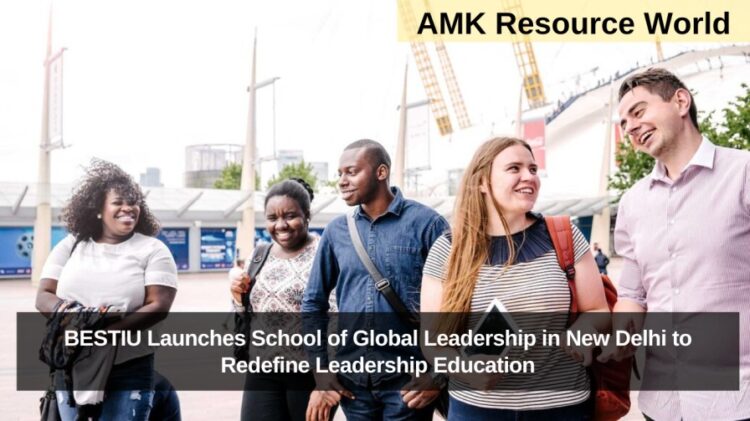
The Bharatiya Engineering Science and Technology Innovation University (BESTIU), in collaboration with the India Foundation, has officially launched the School of Global Leadership (SoGL) in New Delhi, marking a significant step toward reshaping leadership education in India. The initiative aims to address long-standing gaps in conventional leadership training by integrating academics, real-world practice, and global exposure, making it highly relevant for students, young professionals, and policy aspirants in India and across the world.
The launch event, held in the national capital, witnessed participation from policymakers, former diplomats, academics, industry leaders, and young professionals. Discussions focused on the evolving nature of leadership in a multipolar global order, where challenges increasingly span governance, public policy, technology, enterprise, and international engagement.
Why the School of Global Leadership Matters
The School of Global Leadership has been positioned as an academic institution that treats leadership as a serious interdisciplinary discipline, rather than a narrow set of managerial tools. The initiative responds to growing concerns around institutional trust, governance failures, and global cooperation, where leadership shortcomings can have systemic and long-term consequences.
Speaking at the launch, Union Minister for Education Dharmendra Pradhan emphasised that leadership education must go beyond techniques and frameworks. He highlighted that modern leaders operate in environments marked by uncertainty, institutional complexity, and ethical responsibility, often influencing outcomes that affect societies for decades. According to him, leadership education must be grounded in systems thinking, ethical judgement, and the ability to translate ideas into effective action.
India-Centric, Globally Engaged Leadership Model
Jayant Sinha, Chair of the School of Global Leadership, noted that SoGL draws deeply from India’s developmental and governance experience, while remaining actively engaged with global leadership debates. He argued that many contemporary leadership lessons are emerging from societies managing scale, diversity, and rapid transformation, and institutions rooted in these realities can offer valuable insights to the global discourse.
This perspective positions SoGL as a bridge between Global South experiences and international leadership education, offering a model that is both locally grounded and globally relevant.
Practitioner-Led Academic Framework
One of the defining features of the School of Global Leadership is its practitioner-led learning model. The academic framework brings together:
- Former diplomats and policymakers
- Ministers and senior public administrators
- Entrepreneurs, innovators, and industry leaders
- Experienced faculty members
This structure ensures that theory is continuously tested against real-world experience, allowing learners to engage with leadership challenges as they unfold across institutions and sectors.
PGP in Global Leadership (PGP-GL): Programme Overview
At the launch, SoGL introduced its flagship Post Graduate Programme in Global Leadership (PGP-GL). This one-year, full-time programme is designed as a multi-country academic experience, combining classroom instruction with immersive, applied learning.
Key Features of PGP-GL

- Duration: One year (full-time)
- Programme Type: Post Graduate Programme
- Academic Model: Practitioner-led and experiential
- International Residencies:
- India
- China
- United Arab Emirates
- United States
- Italy
- Belgium
- Netherlands
The curriculum covers governance, public policy, strategy, innovation, and ethics, with a strong emphasis on experiential learning and engagement with live institutional and policy challenges.
Learning Structure and Pedagogy
Leadership at SoGL is defined not by position or authority, but by the ability to:
- Interpret complexity
- Exercise informed judgement
- Design, reform, and strengthen institutions in the public interest
The learning structure is built around immersion, reflection, and synthesis, and includes:
- Global Leadership Labs
- Innovation Immersions
- Policy-focused projects
- Institutional challenge engagements
This approach prepares participants to operate effectively across public, private, and international domains.
Quick Reference Summary
| Aspect | Details |
| Institution | Bharatiya Engineering Science and Technology Innovation University (BESTIU) |
| Partner | India Foundation |
| School Launched | School of Global Leadership (SoGL) |
| Location | New Delhi |
| Flagship Programme | Post Graduate Programme in Global Leadership (PGP-GL) |
| Duration | One Year (Full-Time) |
| International Residencies | India, China, UAE, USA, Italy, Belgium, Netherlands |
| Learning Model | Practitioner-led, experiential, policy-focused |
Global Context and Future Outlook
With its launch, the School of Global Leadership enters a growing global space of leadership education initiatives responding to questions around governance, institutional resilience, and global cooperation. As leadership failures increasingly carry system-wide consequences, institutions like SoGL seek to equip future leaders with the capacity to navigate complexity responsibly and effectively.
By combining India’s lived governance experience with international academic exposure, SoGL aims to contribute meaningfully to the global leadership education ecosystem.
The launch of the School of Global Leadership by BESTIU represents a forward-looking approach to leadership education, responding to the realities of a complex, multipolar world. With its practitioner-led pedagogy, global academic exposure, and public-interest orientation, SoGL is positioned to develop leaders capable of shaping institutions and policies with long-term societal impact. Readers are encouraged to visit the official BESTIU website for programme updates and bookmark this page for future developments.