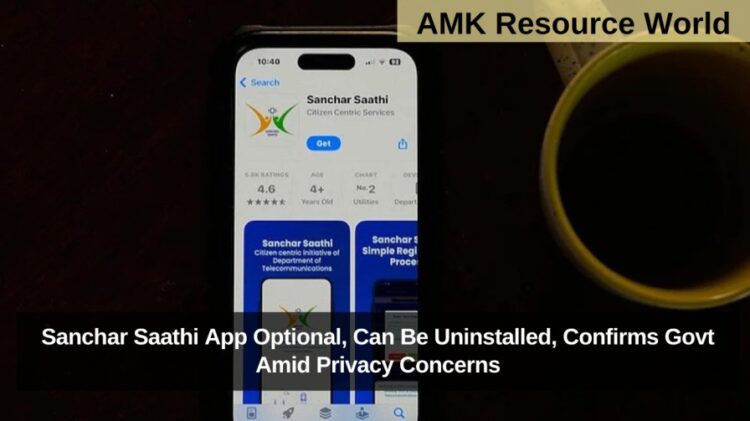
The Department of Telecommunications (DoT) recently issued a directive asking smartphone manufacturers to preload the Sanchar Saathi cybersecurity app on new devices. Initial reports suggested that OEMs would not be allowed to let users disable or uninstall the app, raising widespread concerns about privacy, data monitoring, and device control.
However, the Government of India has now issued a clear clarification, confirming that the Sanchar Saathi app is completely optional. Users are free to activate, deactivate, or uninstall it at any time, just like any other smartphone application. This clarification arrives following confusion and industry concerns, including a Reuters report stating that Apple does not intend to comply with the pre-installation directive on privacy and security grounds.
Government Clarification: Sanchar Saathi Is Optional
Speaking outside Parliament, Union Minister for Communications Jyotiraditya Scindia clarified the government’s stance, stating:
“You can activate or deactivate it as per your wish… If you don’t want Sanchar Saathi, you can delete it. It is optional.”
The minister added that earlier reports claiming the app would be mandatory or permanently installed were misconceptions. He further stated that the app does not enable snooping, call tracking, or surveillance.
Why the Directive Was Issued
The DoT’s recent instructions direct smartphone makers to ensure that the Sanchar Saathi app is pre-installed, visible, functional, and accessible during device setup. Brands must:
- Implement the directive within 90 days
- Submit a compliance report within 120 days
- Push the app to existing devices via software updates
The aim, according to officials, is to provide users immediate access to the app’s safety features, rather than enforce its usage.
What is the Sanchar Saathi App?

Sanchar Saathi is a government-backed telecom safety and fraud detection application. It provides features for:
- Tracking stolen phones
- Blocking lost devices
- Detecting fraudulent mobile connections
- Reporting suspicious numbers
According to the Minister:
- The platform enabled disconnection of 1.75 crore fraudulent mobile connections
- Helped trace 20 lakh stolen phones
- 7.5 lakh recovered phones have been returned to owners
Key Features of the App
- CEIR (Central Equipment Identity Register) for stolen device tracking
- TAFCOP service to check SIMs issued in your name
- Fraud detection alerts
- Tools to ensure telecom identity safety
OEM Concerns & Apple’s Reported Non-Compliance
A Reuters report revealed that Apple may not comply with the directive due to concerns that preloading third-party state-backed apps could compromise the privacy structure of the iOS ecosystem.
While Android OEMs can technically push such apps via OTA updates, Apple restricts forced app installation without explicit user permission.
Quick Reference Summary
| Topic | Details |
| Is Sanchar Saathi mandatory? | No, government confirms it is optional |
| Can users uninstall the app? | Yes, it can be deleted anytime |
| DoT directive | Pre-installation on new and existing devices |
| OEM compliance timeline | 90 days to implement; 120 days to report |
| Privacy concerns | Govt denies snooping; Apple reportedly not complying |
| App purpose | Fraud detection, stolen phone tracking |
| Impact so far | 1.75 crore fraudulent SIMs disconnected; 20 lakh phones traced |
The government’s clarification puts an end to confusion regarding the mandatory installation of the Sanchar Saathi app. While DoT has directed manufacturers to preload the app for easier accessibility, its use remains entirely optional, and users may uninstall it at any time. With significant success in tracking stolen devices and preventing telecom fraud, Sanchar Saathi continues to be an important cybersecurity tool. For further updates regarding policy changes and OEM compliance, stay tuned and bookmark this page.