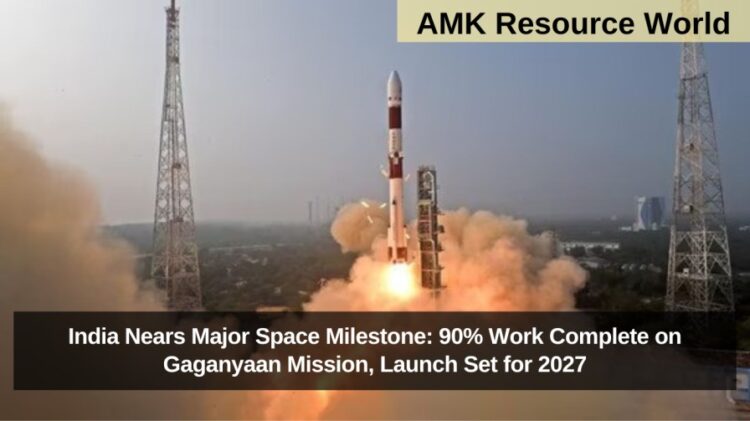
India is on the verge of achieving one of its most ambitious space milestones — the Gaganyaan Mission, which aims to send Indian astronauts into space by 2027. According to Dr. K. Sivan, former Chairman of the Indian Space Research Organisation (ISRO), nearly 90 per cent of the work on India’s first human spaceflight programme has already been completed.
The mission marks a historic step forward in India’s growing space ambitions, showcasing the nation’s ability to develop complex, human-rated systems indigenously. Once launched, Gaganyaan will make India the fourth nation in the world—after the United States, Russia, and China—to successfully send humans into space.
Gaganyaan Mission: India’s Leap Toward Human Spaceflight
The Gaganyaan Mission, announced by Prime Minister Narendra Modi, represents India’s entry into the elite club of spacefaring nations capable of conducting manned space missions. The project will demonstrate ISRO’s ability to launch humans into low-Earth orbit (LEO) using a completely indigenous launch system, including life-support systems, re-entry modules, and crew safety mechanisms.
ISRO Chairman S. Somanath, speaking to DD News, described the mission as “one of the most complex and significant undertakings in India’s space history.” He emphasized that three uncrewed test flights will precede the human mission to validate the crew module, life-support, and re-entry systems before astronauts are cleared for spaceflight.
“These uncrewed missions are critical to proving the safety and reliability of all systems. Once completed successfully, we will be ready to send our astronauts into space,” said Somanath.
Human Spaceflight Preparations Underway
India’s astronaut corps, currently undergoing intensive training in Bengaluru, is preparing for a new era of space exploration. The training program includes simulations, zero-gravity familiarization, and emergency escape drills to ensure crew readiness for every possible scenario.

The crew module, designed to withstand extreme conditions of space travel, features advanced safety systems that can execute abort operations within milliseconds in case of launch anomalies. These systems have undergone extensive ground testing and are being refined for upcoming test missions.
Over the next two years, ISRO will conduct multiple uncrewed test flights under the Gaganyaan programme to validate mission-critical technologies such as heat shields, parachute recovery systems, and environmental control systems. These tests will demonstrate India’s engineering capabilities and mission preparedness ahead of the manned launch in 2027.
A New Era for India’s Space Ambitions
The Gaganyaan Mission is more than just a technological achievement — it is a symbol of national pride and scientific progress. It reinforces India’s position as a global leader in space innovation and exploration.
Experts believe that Gaganyaan will pave the way for future interplanetary missions, including manned lunar and Mars explorations, and will inspire a new generation of Indian scientists and engineers to pursue careers in space technology.
As India prepares for liftoff, the mission embodies the vision of a self-reliant India in space technology, aligning perfectly with the “Atmanirbhar Bharat” initiative.
When Gaganyaan finally lifts off, it will not just carry astronauts into orbit—it will carry India’s dreams, scientific spirit, and global aspirations to new cosmic heights.