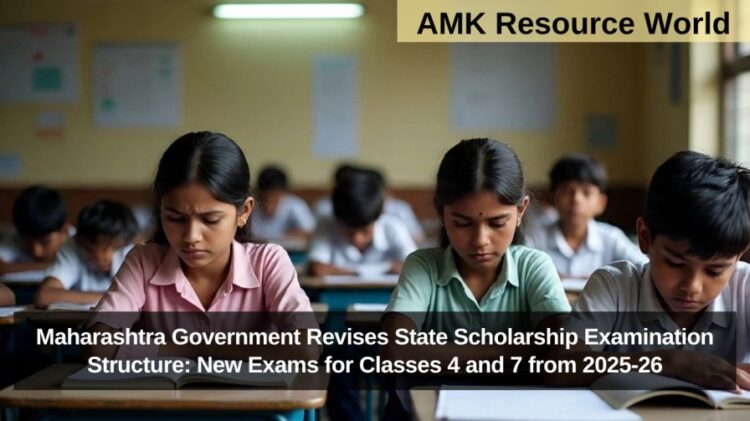
The Maharashtra government has approved a significant revision to the state scholarship examination structure, with the pre-upper primary and pre-secondary exams now set to be conducted for Classes 4 and 7. The updated format will be implemented from the 2025-26 academic year, marking a return to the earlier system that existed before 2015. The decision aims to boost student participation and enhance academic excellence among meritorious and economically disadvantaged students across the state.
Transition Plan for 2025-26
According to an official release, the final Class 5 and Class 8 scholarship exams will be held in February 2026, during the transition phase. The new Class 4 and Class 7 scholarship exams will be conducted separately in April or May 2026. From the 2026-27 academic year onward, the scholarship exams will be conducted regularly for Classes 4 and 7, establishing a new academic pattern.
Revised Scholarship Amount and Distribution
The Maharashtra government has also revised the scholarship amounts to make them more beneficial for students. Under the new structure:
- Class 4 scholarship: ₹5,000 per year
- Class 7 scholarship: ₹7,500 per year
As per official data, 16,693 scholarships will be awarded at the primary level (Class 4) and 16,588 scholarships at the upper-primary level (Class 7). These financial incentives are designed to motivate talented students, particularly those from rural and economically weaker backgrounds, to continue their education without financial burden.
Background of the Scholarship Scheme
The Maharashtra Scholarship Scheme, introduced in 1954-55, was established to identify and support meritorious students from both rural and urban areas. In 2015, the government shifted the examination levels to Classes 5 and 8. However, reports indicated a significant decline in student participation following that change.

To address this issue and encourage early academic development, the state government decided to revert to the original structure of holding exams for Classes 4 and 7. Officials believe this move will help identify promising students at a younger age and provide them with sustained academic support.
Eligibility, Age Limit, and Fees
Under the revised rules, students from all types of schools — including government, aided, unaided, permanently unaided, and self-financed institutions — are eligible to appear for the scholarship examinations. Students studying under CBSE, ICSE, and other recognised boards can also participate, subject to certain conditions.
The age limit for candidates has been defined as follows:
- Class 4 exam: Maximum age of 10 years (and 14 years for students with disabilities)
- Class 7 exam: Maximum age of 13 years (and 17 years for students with disabilities)
The cutoff date for calculating age eligibility is June 1 of the examination year.
The examination fee has been set at ₹200 for general category students and ₹125 for students from Scheduled Caste, Scheduled Tribe, Nomadic Tribe, Denotified Tribe, and disabled categories. Additionally, every participating school will be required to pay an annual registration fee of ₹200 to the Examination Council.
Integration with Vidyaniketan Entrance Tests
The primary scholarship exam (Class 4) will continue to be held jointly with entrance tests for government, tribal, and denotified and nomadic tribe Vidyaniketans, ensuring integrated access to both scholarships and special educational institutions. Each scholarship will remain valid for a period of three years, providing continuous financial assistance to deserving students.
The Maharashtra government’s decision to revise the state scholarship exam structure for Classes 4 and 7 reflects its strong commitment to inclusive and equitable education. By restoring the earlier class levels, increasing scholarship amounts, and expanding eligibility, the initiative aims to revive participation, encourage early academic excellence, and support underprivileged students in achieving their educational aspirations.